Showing posts with label Erbschaft. Show all posts

Thursday, 19 May 2022

Rosehill Model Railway Exhibition 2022 - Part 2

Continuing on from the first instalment about last weekend's Rosehill Model Railway Exhibition, let me continue with some more layouts that grabbed my attention. I'll then finish up with some concluding comments.

A new layout (for me at least) was the HO scale Sydney suburban Carlingford branch terminus railway station. The layout depicts the terminus from the late 1980s to early 1990s. On the prototype, the Carlingford line was a relatively short suburban line (7km) forking off from Clyde on the Sydney Western line. The Carlingford line north of Parramatta Road was closed on 5 January 2020 to allow conversion works to light rail to take place. This also involved the closure of Rosehill station and rail access to Rosehill Racecourse where the exhibition was held. The layout showcased a range of suburban electric sets, including the brightly coloured "Zoo train".


Cockle Creek (N scale) was another NSW-themed layout featuring a range of locomotives and rollingstock from the 1960-1980s. The prototype is situated on the Short North between Sydney and Newcastle. The layout is from the NSW N scale group.


Dungog (HO scale) made another exhibition appearance and continues to display some of the best modelling of the NSW prototype. Dungog is on the Main North Coast Railway line to Brisbane. You can see a wide range of prototypes on the layout as it showcases action from the 1940s to 1970s. I always take time to look at the station and yard infrastructure on this layout as they are of excellent quality. And, of course, one cannot enjoy Dungog without taking note of the iconic layout lighting.


Wingello (HO scale) was another NSW-themed layout being based on the prototype station on the Main South line in the Southern Highlands of New South Wales, 132km from Sydney Central. The layout is from the Georges River Model Railway Club. The layout features a range of trains from the 1960s through to the 1990s. This was a nicely detailed layout with some excellent scratchbuilt structures.

Gunning (N scale) made another appearance, folowing on from Canberra last month. Gunning is a small town on the Main South line and is a popular spot for railway photographers. The layout incorporates the railway station and infrastructure of Gunning, as well as some additional railway structures to the north and south of Gunning itself. 

Also on the Main South line, north of Gunning, is the major regional town of Goulburn. The Guildford Model Railway Club's exhibition layout of Goulburn (HO scale) is a great representation of the station and yard infrastructure. You can always be assured of plenty of railway action on this layout.


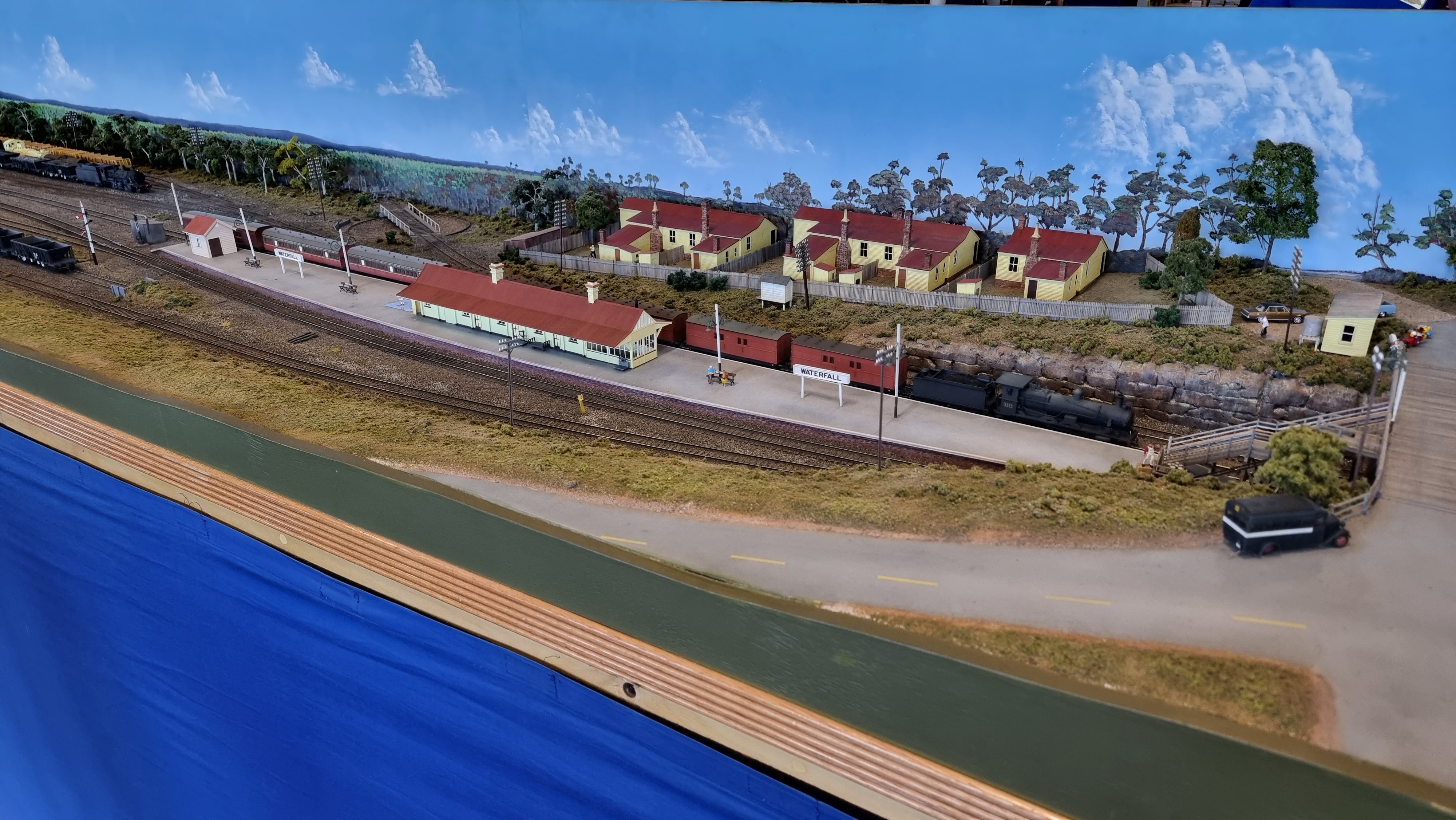
Another favourite on the exhibition circuit is Waterfall (HO scale) from the Illawarra Model Railway Association. The prototype location of Waterfall is 38km south of Sydney Central on the Illawarra line. The period showcased by this layout is the 1960s, well before electification in 1980. All of the buildings and structures are scratchbuilt. Track is Peco Code 83. Operation can be either DC or DCC.
Turning now to some overseas prototypes, we start off with the HO scale US-themed layout, Springfield Junction from the Hills Model Railway Club. This layout has many industries and plenty of railroad action. Operation is with digital command control (DCC).

Erbschaft (HO scale) was a wonderful layout from Ross James and son, particularly given that much of  the buildings, locos and rolling stock came from Ross's father's collection from the 1960s and 1970s. The layout depicts a fictitious West German town in the 1960s. The layout uses the centre-stud Marklin track and locomotives. The buildings are early Faller and Kibri. None look the worse for wear! I spent quite some time enjoying this layout and all it had to offer. A very well composed layout indeed.


Another German layout was Luneberg from the Marklin Modellers Sydney club. The layout features the medieval town of Luneberg in northern Germany. This layout had some very nice buildings, as well as showcasing a variety of trains from Era III to the latest high-speed trains. The layout also uses the Faller car system and the town was well serviced by regular buses.

I'll finish up with another of my favourites from the exhibition: Uley Junction (O scale). The layout is based on a fictitious location but following Great Western Railway (GWR) practices. Being a branch line terminus, there are a number of short trains coming and going, as well as plenty of shunting. The layout showcases two periods of operation - late 1800s-early 1900s, and the 1930s. As such, there is a very interesting array of trains that you can see on this layout throughout the day. The layout uses a turntable fiddle yard (which is pretty big!), being able to hold and turn a train of 1200mm in length.


As well as a great and varied selection of layouts on show at the exhibition, there was also a wide range of commercial vendors as well. These included, ARHS bookshop, Alco World Trains, AndIan Models, Auscision, Bergs Hobbies, Burfitt Tools, Casula Hobbies, Eureka, Euro Hobby, Forest Miniatures, Hobbyland Hornsby, IDR, Ixion, Kerroby Models, Model Railroad Craftsman, Pallas Hobbies, SCMRS, SDS, and Wombat Models. Apologies if I left anybody out. And I cannot forget to mention the exhibition's second-hand stall which is synonomous with the event.

The Epping Model Railway Club is to be congratulated for a first rate exhibition with plenty of layouts and commercial stands to make the day (or weekend) a truly engaging experience. Thanks, fellas!


Sunday, 19 June 2016

Epping Model Railway Club Exhibition 2016

The 2016 Epping Model Railway Club's exhibition last weekend was a good one.  There were 22 layouts on display and 23 commercial exhibits. As usual, the second hand stall was very popular for sellers and buyers alike. The modelling clinics were a little different this year with a focus on building home layouts. The clinics were managed by David L. from the Epping Club in concert with the National Model Railroad Association (NMRA) who manned the stand and answered questions from the public relating to all the facets of building a home layout. Great idea, David!

I caught up with a good many fellow modellers at the exhibition and still managed to actually see the layouts on display. Here is a sample of the layouts that caught the eye of my camera.

Goulburn (Australian/NSW, HO scale) was a new exhibit from the Guildford Model Railway Group. The layout is 6.5 metres (22') long and 2.8 metres (9') deep. The main feature of the layout is a wonderful model of the prototype Goulburn station. Other building features include the long run-through goods shed, steel footbridges, and the workshop area with overhead crane. Trains from the period of the 1960s to the present day made their appearance, reflecting the individual membership's era preferences. The layout is operated by conventional DC control.


Gordon (VR/SAR HO scale) was a layout I had not seen before. It represents the prototype in near the Dandenong Ranges top of the Great Dividing Range between Melbourne and Adelaide. A good variety of Australian locos and rollingstock from the 1960-1980 period was on display. Interestingly, the May and June 2016 issues of Newsrail feature two articles on the prototype Gordon station.


Bullo Pit (British, O scale) is a 7mm/foot scale layout based on a real location in Gloucestershire in the 1920s. The layout represents the tidal inlet from the River Severn and associated rail infrastructure. There was plenty of shunting going on with a range of four-wheeled wagons.


Erbschaft (German, HO scale) is a fictitious town set in the 1960s.  The layout is Marklin with centre-stud track and a good range of locos and rollingstock. Buildings are mainly kit-built structures from Faller and Kibri. Erbschaft was a very nice medium-sized layout.


Over the Fence (Australian/NSW, HO scale) was a new layout to the Epping exhibition, although it had debuted at Sandown in Melbourne earlier in the year. Once again the houses and buildings on the layout represented superb renditions of real structures modelled to scale in styrene. A double-track main line kept trains moving throughout the day; a highlight being the running of an Auscision Countrylink XPT that looked superb snaking its way to the rear of the houses. The durable H&M Clipper transformer powers the trains and never seems to miss a beat.


Oddwalls (NSW, HO scale) made another exhibition appearance from the craftsmanship of Geoff Small. Oddwalls represents a fictitious rural NSW town set in the 1960s. The station area with the main street and country-style buildings are the central scenic highlight of the layout with plenty of detail to be spotted throughout. This layout is compact-sized and an entertaining NSW-themed layout that runs well and looks great.


Wumbat (NSW, HO scale) represents another fictitious NSW rural-based layout. The layout dimensions are 3 metres by 1.2 metres and consists of six modules. Note the impressive way the layout is displayed in a theatre-box style of presentation.


Industry Lane (British, OO scale) is based on a fictitious industrial branch serving a number of industries: fuel/oil, cement, and a large manufacturing complex. The focus of the layout is shunting and this is accomplished using short wheel-based freight wagons and a single locomotive operated with digital command control (DCC). The entire layout, including fiddle yard, is only 1.5 metres (5') in length. The fiddle yard uses a sliding traverser to move trains on and off the layout. I really enjoyed this layout and admired what could be achieved in a relatively small space. Industry Lane was my favourite layout from the exhibition.
 

Moonan Flats (NSW, O scale) represents a what-might-have-been scenario had the real railway reached this town in the Barrington Tops of NSW. The station layout is simple but highly detailed, enabling a good showcasing of NSW outline O scale locomotives and rollingstock.


Wallerawang Junction (Australian/NSW, HO scale) is based on the prototype station on the Main Western line beyond Lithgow. The era modelled is the 1960 to mid-70s period when Wallerawang was a busy rail station and yard. There was plenty of steam and diesel train action on this layout.


Bullenbung Creek (NSW, HO scale), the featured layout at the Modelling the Railways of NSW Convention earlier this year, made its first Epping exhibition appearance. The layout took its inspiration from Belfrayden on the Uranquinty-Kywong branch line. This lightly-trafficed rural branchline has been well modelled using hand-laid code 55 rail soldered to PCB sleepers. The layout is operated using DCC and locos all have sound. My favourite was the 24 class (2417 pictured below) which performed its duties with no-fuss aplomb.


The Yard (NSW, HO scale) was another NSW-themed layout making its first appearance on the exhibition scene. The focal point is indeed the yard and the Pioneer cement silos. Other rail-served industries included stock pens, loading ramp and goods shed. Track is Peco code 83 with insulfrog points operated by Tortoise switch motors. The layout uses an NCE Pro Cab for DCC operation.


Stikodelom (NSW, O scale) showcased some quality O scale locomotives, rollingstock and scenery. The location is fictitious but certainly has that generic rural NSW feel about the place. The Beyer-garrat (pictured below) is a very impressive sight in this scale.


Bethungra was the new layout from the Epping Model Railway Club making its debut exhibition appearance. The trees on the layout are superb (well done, Phil). Unfortunately, I don't have any photos but can direct you to this Youtube clip from John Thoroughgood who captured the layout in a nice two minute video.

And of course, there was the ever-popular Lego layout.


I really enjoyed the exhibition and the opportunity to chat with friends from the hobby.  I'd like to thank the Epping Model Railway Club for another successful event.