The Canberra Model Railway Expo is on again this year. There will a range of layouts and a good selection of commercial vendors. I know that Micro Models Hobbyland from Hornsby, and Model Railroad Craftsman from Blacktown will be in attendance.
The location of the exhibition is the same as in previous years: University of Canberra High School, 104 Baldwin Drive, Kaleen. Opening hours are 9am-5pm on Saturday (28 March) and 9am-4pm on Sunday (29 March).
Entrance fees are very reasonable: $10 each for adults, $5 each for children and seniors, and family admittance for $20 (two adults and two children).
The National Model Railroad Association (NMRA) will have a stand at the exhibition on both days featuring the WWI diorama/layout of Mr D. Low. The NMRA Australasian Region has good representation around the country these days and the Canberra group is no exception.
At this stage, I am planning on being at the expo on both days from mid-morning onwards. I hope to catch up with modellers then.
Friday, 27 March 2015

Sunday, 1 February 2015
Rules and playing the game
As mentioned in my previous blog post, I went to Cancon in Canberra to check out the way in which miniature wargames and even board games use rules to simulate some aspect of reality. It was difficult to follow some of the WWII miniature wargames with the complexities involved but I nevertheless came home with these three rule books to examine at my leisure.

These rule books, and others including the popular Flames of War, seek to represent different conflicts (principally WWII) in terms of geographic location, battle contexts, and military personnel and equipment. Establishing the right combination of personnel and equipment (e.g. number of soldiers and number of tanks) is necessary for each "game". Added complexity comes into play when dealing with levels of experience and resilience to stress in combat situations; psychological aspects that seek to simulate real life situations and add operational interest. Some miniature wargames include aircraft to add another layer of complexity.
The upshot is that these wargames rely on history (and research) for their operational contexts. While not mandatory, having a good understanding of the history enhances the experience of the game. The games also rely on geography and the types of equipment rosters applicable at the time and place. Such characteristics are very similar to those in the model railroad hobby. Also very similar to the model railroading experience is the commercial side of the hobby with various books and magazines, kits, detail parts, hobby tools and accessories, and paints and powders all available at the show.
There are of course some differences between the two hobbies However, I am more interested in finding out whether aspects of the wargaming experience (e.g. the rules and the "playing") can be applied to enhance the operational enjoyment of model railroads. I need to read more and talk with more wargamers to better understand what they do and how they do it.
That said, I would be interested in hearing from any dual code modellers (wargaming and model railroading) to get their perspective on the operational aspects of both hobbies.
These rule books, and others including the popular Flames of War, seek to represent different conflicts (principally WWII) in terms of geographic location, battle contexts, and military personnel and equipment. Establishing the right combination of personnel and equipment (e.g. number of soldiers and number of tanks) is necessary for each "game". Added complexity comes into play when dealing with levels of experience and resilience to stress in combat situations; psychological aspects that seek to simulate real life situations and add operational interest. Some miniature wargames include aircraft to add another layer of complexity.
The upshot is that these wargames rely on history (and research) for their operational contexts. While not mandatory, having a good understanding of the history enhances the experience of the game. The games also rely on geography and the types of equipment rosters applicable at the time and place. Such characteristics are very similar to those in the model railroad hobby. Also very similar to the model railroading experience is the commercial side of the hobby with various books and magazines, kits, detail parts, hobby tools and accessories, and paints and powders all available at the show.
There are of course some differences between the two hobbies However, I am more interested in finding out whether aspects of the wargaming experience (e.g. the rules and the "playing") can be applied to enhance the operational enjoyment of model railroads. I need to read more and talk with more wargamers to better understand what they do and how they do it.
That said, I would be interested in hearing from any dual code modellers (wargaming and model railroading) to get their perspective on the operational aspects of both hobbies.
Friday, 23 January 2015
Model railways as a game
Welcome to Armchair Modeller Down Under in 2015.
Last year was a rather quiet year with my time taken up with a number of other activities. I hope this year will allow me some spare time to publish regular posts here and in sister blog, DME Down Under.
One of the themes I want to cover this year is gamification. Briefly, gamification is the use of game thinking and game mechanics in non-game contexts to engage users in solving problems and increase users' self contributions. In the context of model railways where we seek to draw inspiration from the prototype, I want to investigate some of the thinking around gamification and how other hobbies, such as wargamers, combine elements of gamification with historical or contemporary real life practices. Gamification is also important in other fields such as education and technology development.
In model railways, many of us want to simulate prototype railway operation on our layouts to increase our enjoyment of the hobby and to give a sense of purpose. At the same time, we cannot always exactly replicate the prototype (although there are modellers who aim for such perfection) and therefore compromise prototype operational authenticity to increase modelling potential and other operational practicalities. Gamification is something I am interested in furthering my knowledge about to see if there are elements I can use to increase the enjoyment of my model railway.
And this is one reason why I will be attending Cancon this Australia Day long weekend in Canberra. I will be interested in the different forms of wargaming, in particular the rules and concepts, which underlie the actual playing of the game. As people know, wargaming is often based on an extensive knowledge of historical conflicts with as much enthusiasm and detail as many in the hobby of model railways. There is definitely a connection to history and research that both hobbies share.
In addition, the range of paints and ancillary items for sale at Cancon are of use in both hobbies and are an added bonus. I especially enjoy talking with people about the painting techniques of wargame miniatures which is indeed a very special skill.
So, with this rather offbeat introduction to the year, I hope that you will find this and future blog posts on Armchair Modeller Down Under of continued interest.
Last year was a rather quiet year with my time taken up with a number of other activities. I hope this year will allow me some spare time to publish regular posts here and in sister blog, DME Down Under.
One of the themes I want to cover this year is gamification. Briefly, gamification is the use of game thinking and game mechanics in non-game contexts to engage users in solving problems and increase users' self contributions. In the context of model railways where we seek to draw inspiration from the prototype, I want to investigate some of the thinking around gamification and how other hobbies, such as wargamers, combine elements of gamification with historical or contemporary real life practices. Gamification is also important in other fields such as education and technology development.
In model railways, many of us want to simulate prototype railway operation on our layouts to increase our enjoyment of the hobby and to give a sense of purpose. At the same time, we cannot always exactly replicate the prototype (although there are modellers who aim for such perfection) and therefore compromise prototype operational authenticity to increase modelling potential and other operational practicalities. Gamification is something I am interested in furthering my knowledge about to see if there are elements I can use to increase the enjoyment of my model railway.
And this is one reason why I will be attending Cancon this Australia Day long weekend in Canberra. I will be interested in the different forms of wargaming, in particular the rules and concepts, which underlie the actual playing of the game. As people know, wargaming is often based on an extensive knowledge of historical conflicts with as much enthusiasm and detail as many in the hobby of model railways. There is definitely a connection to history and research that both hobbies share.
In addition, the range of paints and ancillary items for sale at Cancon are of use in both hobbies and are an added bonus. I especially enjoy talking with people about the painting techniques of wargame miniatures which is indeed a very special skill.
So, with this rather offbeat introduction to the year, I hope that you will find this and future blog posts on Armchair Modeller Down Under of continued interest.
Sunday, 30 March 2014
Canberra Model Railway Expo 2014

The 26th Canberra Model Railway Expo was held over weekend (29-30 March) at Kaleen High School, a northern suburb of Canberra. The Expo was organised by the Canberra Model Railway Club. Once again, this exhibition was a great way to see plenty of model railway action and to shop at the numerous commercial outlets. There were over 50 exhibits and commercial stands in all.
Here is a selection of layouts that caught my eye during the afternoon today.
The first image shows the layout, Binabeen. This layout is under new ownership in Goulburn, having been called Willigobung by the previous Canberra-based owners. Binabeen is a HO scale NSW layout representative of the type of large layout facilities on the double-track Main South Line.

Another HO scale NSW layout on display was Binalong from the Epping Model Railway Club in Sydney. The layout is based on the real Binalong which is also on the Main South line. Binalong won the award for best layout on show. In the image we see a streamlined 38 class pausing at the station with a Melbourne-bound passenger service.

The next image is from the 638 Mile layout, a HO scale NSW-themed layout. The 638 means that the location is 638 miles from Sydney. The layout is operated by DCC (digital command control) using NCE equipment. The image below shows a 620/720 railcar set in "candy stripe" livery leaving the station.

The wonderful O gauge layout, Arakoola, was on display, featuring a mix of steam and early diesel locomotives set in a rural NSW yard environment. The layout showcases some superb modelling and demonstrates what can be achieved in the larger scale. A photographic backdrop provides good depth to the modelled portion of the layout, as can be seen in the photo below. In the photo, a 50 class standard goods locomotive sits simmering in the yard awaiting the ok to proceed down the line.

Some Sydney-themed layouts were also on display. The suburban Yendys layout was exhibited by thee ACT Model Railway Society. Yendys is a HO scale layout operated by DCC. The image below shows an interurban set about to depart the station.

Mungo Scotts is an HO scale layout based on the Mungo Scott flour mill facilities near Lilyfield in Sydney. The rail line is now used by the recently opened Dulwich Hill tramway extension. The HO scale layout depicts the line in its days as a freight operation.

Another HO scale NSW layout was Electric Car Sheds that featured a selection of electric passenger and goods trains based in a typical electric car shed environment in Sydney.

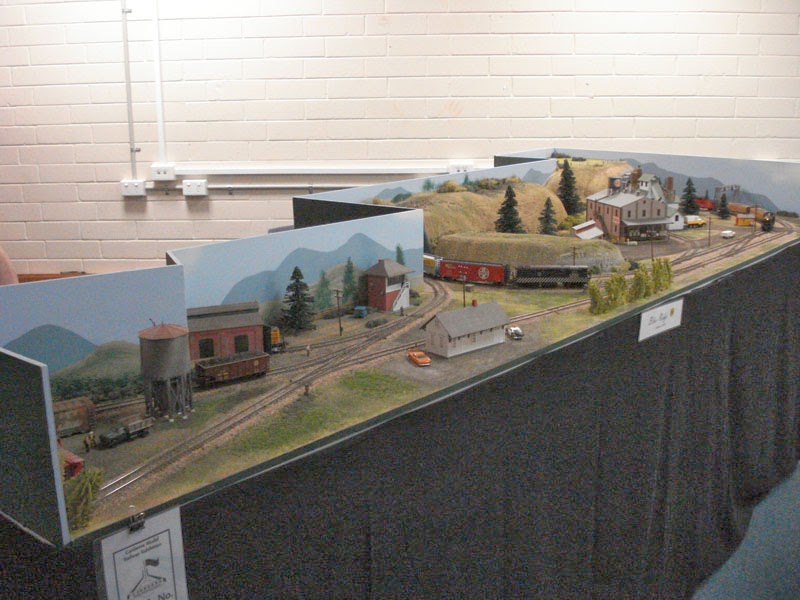
Blue Ridge is an HO scale US-themed layout that showed what can be achieved in a relatively small space. The layout would fit easily into a standard sized bedroom and uses standard commercially produced locomotives, rolling stock and buildings. The layout was based on the southern end of the Cascade Mountains in California where the McLeod River Railroad had its operations. The layout was run on DC and I was impressed by the smooth-running of the trains even late on the final afternoon of the exhibition.
And rounding out the day for me was the compact N scale layout, Midford. One of the things I like about N scale is the buildings and Midford had some good examples.

There were plenty of other layouts and commercial stands at the exhibition to provide for a wide range of interests. I hope the exhibition was a success for the organisers because it was well worth the visit, especially on a rainy Canberra weekend.
Saturday, 8 February 2014
Model Railroad Planning 2014
Just got my copy of Model Railroad Planning 2014 direct from Kalmbach Publishing. As usual, it is full of interesting articles and some excellent model railroad photography.

The first article is "operating a busy passenger terminal" which is based on the New Orleans Passenger Terminal (NOUPT). The modelled station is huge and exceptionally well done, including fully lit interiors. The layout is HO scale.
The next article is the "Southern Pacific's Siskiyou Line" in N scale. The layout size is 25 x 27 feet which is pretty big for an N scale layout. One of the things I like about the articles in MRP is the emphasis on the decision-making process in designing a layout. This article didn't disappoint in that department.
"Alice Street in 4x8 feet" is a prototypical track plan based on the Santa Fe rail-marine operation out of Oakland, California. There are some fascinating historical photos (B&W) here.
The next article is called "A moving experience" about a layout built for a newly purchased retirement home. The original layout based on Moscow, Idaho (I think the Americans pronounce it moss-cow) was featured in Model Railroad Planning in 2008.
My favourite article is "Switching for breakfast". This article describes the prototypical train operations for switching (shunting) the large Post Cereals food complex at Battle Creek, Michigan. A description of a typical shift switching the industry was very informative. For me, the best part of the article was a table showing the different spots (positions) within the Post Cereals complex that had to be switched with what particular product (receiving and shipments). This table alone gave me plenty of food for thought in just what variety can be achieved with a single, large industry on a model railroad. A HO and N scale track plan accompanies the article providing suggestions for how the prototype can be modelled.
A short article on five layouts in four different scales that occupy 14 x 34 inches was next.
Lance Mindheim follows with an article, "Simple plan, plenty of action" based on a southeastern USA switching layout. Lance makes a nice distinction between planning and design - planning deals with more strategic issues that will inform the decisions about overall layout design (track arrangements, for example.). The suggested model railroad layout plan is for a room size of 12 x 13 feet. Lance includes both a plan of the layout and a plan showing switching options.
"Big train, small layout" has an interesting circular design based on a figure eight. It is a portable layout used for model railroad exhibitions and is a little bit different to the norm.
Byron Henderson's article, "North Western's Chicago commute" offers some thoughts about a model railroad track plan 8 x 20 foot in size. The layout is based on the Chicago & North Western's commuter services between the North Western station and the western suburbs of Chicago. Again, the thinking behind the layout design is what is key to this article.
"Slogging up to Locust Summit" is a model railroad based on the Reading Co.'s train operations over Locust Summit near Gordon, Pennsylvania. The track plan fits into a space of 31 x 40 feet and includes plenty of big hauling steam locomotives on this predominantly coal-hauling route. An interesting depiction of a typical day at Gordon gives a nice summary on operations. There are some nice model photographs in this article as well.
Tony Koester next goes out on a bit of a limb with an idea about modelling the same town on two decks and switching cars between them. This idea could be a way to save on available space.
My other favourite article from Model Railroad Planning 2014 is the article by James McNab: "Choosing the right place at the right time". The article describes the importance of time and place in consideration of design and the need for being selective about motive power and rolling stock. It is important to balance traffic levels for certain times of the year (for example, seasonal factors play a major role in agricultural production). James' layout is the Iowa Interstate Grimes Line. The article has both model and prototype photos. Videos of this layout are available on the Model Railroader website to registered viewers: see www.ModelRailroader.com
Model Railroad Planning 2014 ends with articles on staging yards, improving a published (Atlas) track plan, space-saving use of "wye-less wyes", dummy tracks, and modelling a passenger terminal in 15 x 18 feet.
While the focus of the annual is on US modelling and prototypes, there is enough information and thinking potential here for anyone interested in model railways to find something of use. As usual, this publication is of high quality and recommended.
The first article is "operating a busy passenger terminal" which is based on the New Orleans Passenger Terminal (NOUPT). The modelled station is huge and exceptionally well done, including fully lit interiors. The layout is HO scale.
The next article is the "Southern Pacific's Siskiyou Line" in N scale. The layout size is 25 x 27 feet which is pretty big for an N scale layout. One of the things I like about the articles in MRP is the emphasis on the decision-making process in designing a layout. This article didn't disappoint in that department.
"Alice Street in 4x8 feet" is a prototypical track plan based on the Santa Fe rail-marine operation out of Oakland, California. There are some fascinating historical photos (B&W) here.
The next article is called "A moving experience" about a layout built for a newly purchased retirement home. The original layout based on Moscow, Idaho (I think the Americans pronounce it moss-cow) was featured in Model Railroad Planning in 2008.
My favourite article is "Switching for breakfast". This article describes the prototypical train operations for switching (shunting) the large Post Cereals food complex at Battle Creek, Michigan. A description of a typical shift switching the industry was very informative. For me, the best part of the article was a table showing the different spots (positions) within the Post Cereals complex that had to be switched with what particular product (receiving and shipments). This table alone gave me plenty of food for thought in just what variety can be achieved with a single, large industry on a model railroad. A HO and N scale track plan accompanies the article providing suggestions for how the prototype can be modelled.
A short article on five layouts in four different scales that occupy 14 x 34 inches was next.
Lance Mindheim follows with an article, "Simple plan, plenty of action" based on a southeastern USA switching layout. Lance makes a nice distinction between planning and design - planning deals with more strategic issues that will inform the decisions about overall layout design (track arrangements, for example.). The suggested model railroad layout plan is for a room size of 12 x 13 feet. Lance includes both a plan of the layout and a plan showing switching options.
"Big train, small layout" has an interesting circular design based on a figure eight. It is a portable layout used for model railroad exhibitions and is a little bit different to the norm.
Byron Henderson's article, "North Western's Chicago commute" offers some thoughts about a model railroad track plan 8 x 20 foot in size. The layout is based on the Chicago & North Western's commuter services between the North Western station and the western suburbs of Chicago. Again, the thinking behind the layout design is what is key to this article.
"Slogging up to Locust Summit" is a model railroad based on the Reading Co.'s train operations over Locust Summit near Gordon, Pennsylvania. The track plan fits into a space of 31 x 40 feet and includes plenty of big hauling steam locomotives on this predominantly coal-hauling route. An interesting depiction of a typical day at Gordon gives a nice summary on operations. There are some nice model photographs in this article as well.
Tony Koester next goes out on a bit of a limb with an idea about modelling the same town on two decks and switching cars between them. This idea could be a way to save on available space.
My other favourite article from Model Railroad Planning 2014 is the article by James McNab: "Choosing the right place at the right time". The article describes the importance of time and place in consideration of design and the need for being selective about motive power and rolling stock. It is important to balance traffic levels for certain times of the year (for example, seasonal factors play a major role in agricultural production). James' layout is the Iowa Interstate Grimes Line. The article has both model and prototype photos. Videos of this layout are available on the Model Railroader website to registered viewers: see www.ModelRailroader.com
Model Railroad Planning 2014 ends with articles on staging yards, improving a published (Atlas) track plan, space-saving use of "wye-less wyes", dummy tracks, and modelling a passenger terminal in 15 x 18 feet.
While the focus of the annual is on US modelling and prototypes, there is enough information and thinking potential here for anyone interested in model railways to find something of use. As usual, this publication is of high quality and recommended.
Friday, 13 December 2013
Opinion
In my role of armchair modeller, I tend to spend quite a bit of time reading model railway magazines and blogs on model railway topics. They all pretty much give an opinion or two on some aspect of the hobby or on life in general. For example, you can see some of the blog sites in my blog roll that I will often refer to, even if the updates are as slow as my own! What amazes me, however, is how worked up some people can be in their derision of people's modelling preferences and their modelling efforts, and in some cases, the person as well. Model railroading is supposed to be fun, is it not?
Recently, I was going through the blog of US modeller Lance Mindheim. Lance had his layout featured in the December 2013 issue of Model Railroader. The layout is a great example of taking inspiration from the prototype (Miami, Florida, in this case) and building a really nice model railroad. The composition and scenic elements of the layout are superb. There really should be no doubt that Lance is darn good modeller with a quality model railroad. And, as an aside, I hear Lance is to be a guest speaker next Easter at the New Zealand Model Railway Convention in Hamilton, New Zealand (home of the Chiefs rugby union team).
In Lance's blog entry for 30th November 2013, entitled "Live by the sword, die by the sword", Lance has compiled a number of derogatory comments from a UK forum about his layout and his layout article in Model Railroader. It seems that there are some people who don't like the dimensions of Lance's layouts. Building layouts using a standard 6' by 1' baseboard size irks some people. Other comments are critical of Lance's views about model railroading, particularly his expression about "modelling the ordinary". One US commentator didn't like the fact that an image of Lance's layout in Model Railroader had been digitally enhanced with the addition of a photo backdrop instead of showing the basement plumbing!
Lance shrugs off these comments and so he should. Lance is a very good modeller; one who thinks seriously about his modelling while at the same time enjoying the hobby as well. One of the greatest ironies from the criticisms is the fact that the UK model railroad magazines regularly feature micro-layouts which gives pause for thought for those who don't like shunty-plank designs!
The other interesting observation from these criticisms is the comment about Lance's personal views that he expresses sometimes in his model railroad blog and in his other blogs. Personally, I don't know why this is a problem when millions of bloggers around the world are just airing their opinion on pretty much everything. Blogs, by their very nature, are opinion pieces. I could go on, but I don't want to offend anyone with a lecture on the impact of social media on contemporary society...
Whatever ones opinion and whatever the way one chooses to express it, the model railway hobby includes people with umpteen different views on everything from layout planning to scenic detail and operational preferences. Note that I am talking about opinion, not fact. HO scale is 3.5mm to the foot - that's a fact without too much argument. Opinions about a layout in HO scale is another matter. The variety in what modellers do in HO scale (and other scales) is enormous and something we should cherish no matter what our own selective interests may be.
Variety and newness can help instigate our own thinking, whether it emanates from some feature we dislike on a layout or something we find fresh and appealing. Sometimes something that didn't interest us last year is now of immense importance as it now coincides with some modelling work we are doing now, rather than previously when we had just a passing interest. Newness can thus mean relevance at a certain point in time.
People are in the hobby for a range of different reasons and with a range of different skill sets. Individual preferences will abound but we are all part of our common hobby. Like humanity itself, essentially we are all the same. Where we differ in our preferences and approaches in doing things, we should take the opportunity to enhance our knowledge rather than simply deride those who take a different path to our own. It would be a boring hobby and a boring Australia if it were any other way.
That said, may you all have a safe and enjoyable festive season and New Year.
Recently, I was going through the blog of US modeller Lance Mindheim. Lance had his layout featured in the December 2013 issue of Model Railroader. The layout is a great example of taking inspiration from the prototype (Miami, Florida, in this case) and building a really nice model railroad. The composition and scenic elements of the layout are superb. There really should be no doubt that Lance is darn good modeller with a quality model railroad. And, as an aside, I hear Lance is to be a guest speaker next Easter at the New Zealand Model Railway Convention in Hamilton, New Zealand (home of the Chiefs rugby union team).
In Lance's blog entry for 30th November 2013, entitled "Live by the sword, die by the sword", Lance has compiled a number of derogatory comments from a UK forum about his layout and his layout article in Model Railroader. It seems that there are some people who don't like the dimensions of Lance's layouts. Building layouts using a standard 6' by 1' baseboard size irks some people. Other comments are critical of Lance's views about model railroading, particularly his expression about "modelling the ordinary". One US commentator didn't like the fact that an image of Lance's layout in Model Railroader had been digitally enhanced with the addition of a photo backdrop instead of showing the basement plumbing!
Lance shrugs off these comments and so he should. Lance is a very good modeller; one who thinks seriously about his modelling while at the same time enjoying the hobby as well. One of the greatest ironies from the criticisms is the fact that the UK model railroad magazines regularly feature micro-layouts which gives pause for thought for those who don't like shunty-plank designs!
The other interesting observation from these criticisms is the comment about Lance's personal views that he expresses sometimes in his model railroad blog and in his other blogs. Personally, I don't know why this is a problem when millions of bloggers around the world are just airing their opinion on pretty much everything. Blogs, by their very nature, are opinion pieces. I could go on, but I don't want to offend anyone with a lecture on the impact of social media on contemporary society...
Whatever ones opinion and whatever the way one chooses to express it, the model railway hobby includes people with umpteen different views on everything from layout planning to scenic detail and operational preferences. Note that I am talking about opinion, not fact. HO scale is 3.5mm to the foot - that's a fact without too much argument. Opinions about a layout in HO scale is another matter. The variety in what modellers do in HO scale (and other scales) is enormous and something we should cherish no matter what our own selective interests may be.
Variety and newness can help instigate our own thinking, whether it emanates from some feature we dislike on a layout or something we find fresh and appealing. Sometimes something that didn't interest us last year is now of immense importance as it now coincides with some modelling work we are doing now, rather than previously when we had just a passing interest. Newness can thus mean relevance at a certain point in time.
People are in the hobby for a range of different reasons and with a range of different skill sets. Individual preferences will abound but we are all part of our common hobby. Like humanity itself, essentially we are all the same. Where we differ in our preferences and approaches in doing things, we should take the opportunity to enhance our knowledge rather than simply deride those who take a different path to our own. It would be a boring hobby and a boring Australia if it were any other way.
That said, may you all have a safe and enjoyable festive season and New Year.
Saturday, 16 November 2013
Scale ACT 2013
The ACT Scale Modellers' Society has it's annual Scale ACT event this weekend at Kaleen High School in Canberra (also the venue of the annual Canberra Model Train Expo which will be on again next year 29-30 March).
There is a range of models on display including aircraft, shipping, and military armour such as tanks. Here are three images of what you can see from the many models on display throughout the venue.


In addition to the models on display, there are many commercial stands selling kits, after-market detail parts, decals, and modelling tools. Rather surprisingly, there were hardly any jars or tins of paints for sale from any of the vendors. This was disappointing as I was expecting to be able to see a wide range of brands and paint colours used in aircraft and military modelling. It looks like I will have to wait until the Australia Day holiday weekend in January when Cancon comes to town with the war gamers and military modelling vendors.
If you like plastic kit modelling and want to see some good quality examples, then take a visit to Scale ACT at Kaleen this weekend.
There is a range of models on display including aircraft, shipping, and military armour such as tanks. Here are three images of what you can see from the many models on display throughout the venue.


In addition to the models on display, there are many commercial stands selling kits, after-market detail parts, decals, and modelling tools. Rather surprisingly, there were hardly any jars or tins of paints for sale from any of the vendors. This was disappointing as I was expecting to be able to see a wide range of brands and paint colours used in aircraft and military modelling. It looks like I will have to wait until the Australia Day holiday weekend in January when Cancon comes to town with the war gamers and military modelling vendors.
If you like plastic kit modelling and want to see some good quality examples, then take a visit to Scale ACT at Kaleen this weekend.
Subscribe to:
Posts (Atom)