Monday, 16 May 2022

The 2022 Rosehill Model Railway Exhibition

Congratulations to the Epping Model Railway Club for an absolutely fantastic model railway exhibition at Rosehill racecourse. After two false starts in 2020 and 2021 because of Covid-19, it was great to have this exhibition back in business as it is truly one of the best in the country.

This exhibition was a two day affair instead of the usual three day exhibition. Talking to exhibitors, they were pretty happy with a two day event. I don't know what the patronage was over the weekend, but on Saturday when I attended it was pretty busy, both inside the second hand section and the the exhibition proper. The venue (and the sunny weather) was excellent with good lighting, plenty of aisle space and a great range of layouts and commercial stands.

I had pre-booked and entry mid-morning Saturday was easy. The $20 entry fee, at first glance, seemed a bit high but everything seems to be expensive at the moment. That said, when I consider I was there for about five hours, enjoyed the layouts and catching up with people, then a $20 entry fee was good value.

Before I go any further, let's see a sample of some of the layouts on show.

First up is Yendys (HO scale) from the ACT Model Railway Society. As you can see from the exhibition plaques in the second photo below, this layout has done a lot of shows. It is a very good layout and always worth a good look. As always, click on the image to expand. 

Next up was the Peterborough Line, an interesting layout with separate vignettes showing the Light River bridge (photos) and Tarlee. The layout is HO scale and set in the 1982-86 era when Australian National trains plied the rails. I look forward to seeing further developments on this layout in the future.

The popular Binalong layout (HO scale) from the Epping Model Railway Club made another exhibition appearance. This layout is always a pleasure to view.

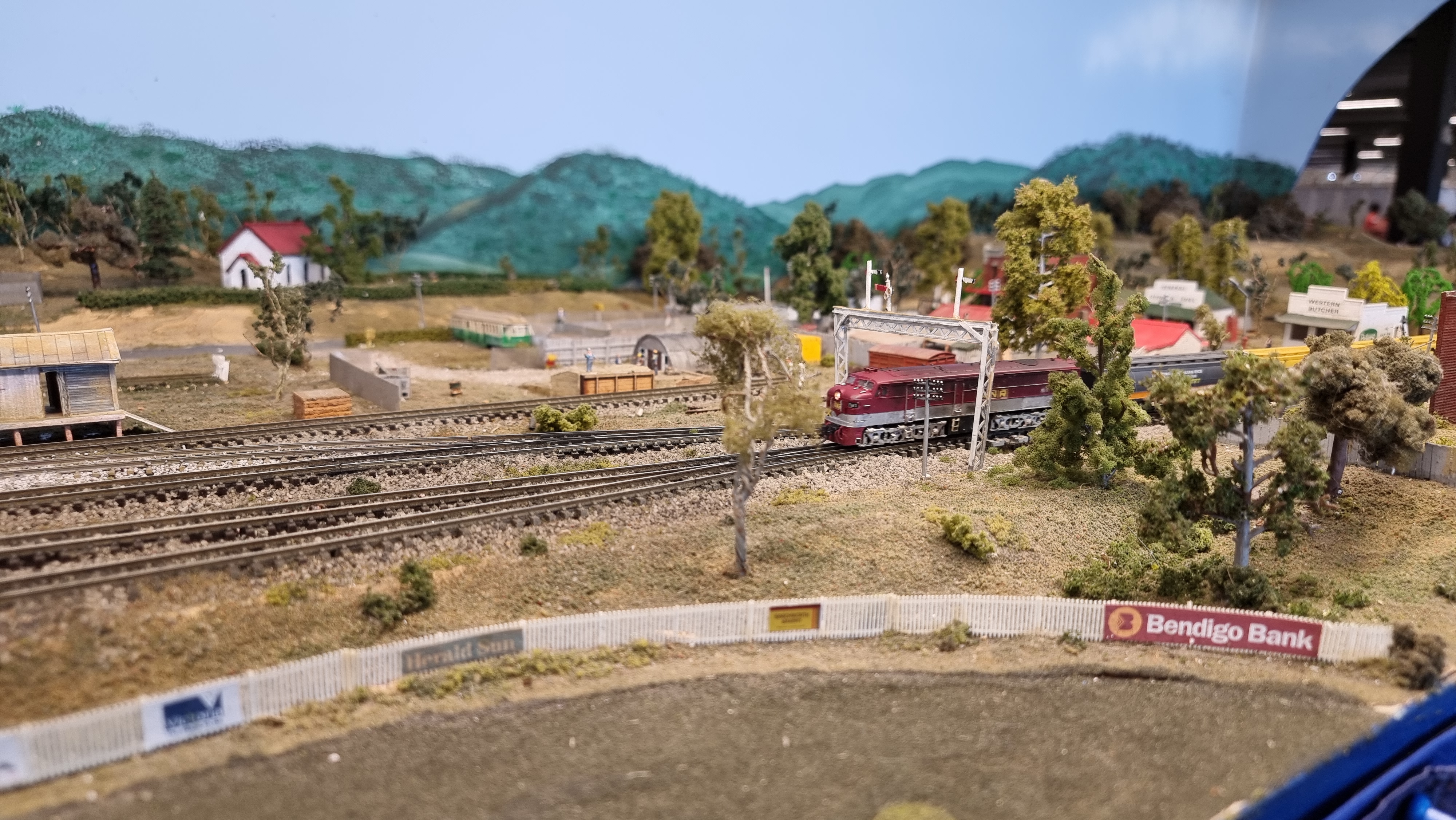
Widgeree (N scale) was a new layout to me and one that packs a lot of model railway into a scene. The layout is from the Sydney N Scale Model Railway Club. The layout is based on a small country town in the goldfields region of Victoria on the Castlemaine to Maryborough line in the early 1980s. The layout showcases a wide range of locos and rolling stock from club members.

The Canadian-themed Cheakamus Canyon in HO scale was an amazing layout set in the mountains of British Columbia. The layout features a number of bridge scenes, all based on real locations. The scenery was built using plaster castings on a foam base. The enormity of the scenic areas really place the trains in context. The layout was featured in the December 2021 issue of Continental Modeller. This layout is one to look out for at future exhibitions.

One of the highlights was the HO scale layout Burrowa. This layout is now 30' long (just over 9 metres) and well-scenicked using static grass and various coloured fibres. The slow pace of this branch line replicates the prototype nicely. The layout modules are are constructed using aluminium frames with plywood and foam superstructure. The station and associated buildings were all scratchbuilt, save for the S008 grain silos. The control panel uses the DCC Concepts Alpha Central for switching the points. I really love this layout and enjoyed talking to Peter, the owner/builder, about its construction.


In contrast by size, my other favourite layout was the wonderful Cass layout (HO scale) set in the mountains of West Virginia, USA, located a "ways up" the Chesapeake & Ohio Greenbrier Division. This layout was new to me. The layout featured shay lumber workings of the Cass, and then later, Mower Lumber companies. Note in the photos below the wonderful shay (brass) and how the right side of the layout extends back deep to give the layout a strong sense of depth but within a relatively small amount of space. The layout was constructed dusing Qubelok aluminium and foam core board which makes this layout light and easy to transport. This layout was superb.

Another layout I saw for the first time was the Queensland Railways HOn31/2 Walloon from the Logan District Model Railway Club. The layout is set in the 1960-80 period with a good variety of locos and rolling stock. In particular, the station buildings and the church were very nicely made and contributed to the realism of the associated scenery.


Another layout I was very impressed with was Over the Fence (NSW, HO scale). This layout is loosely modelled on Adamstown (including the station). The layout features some wonderful suburban houses and cameo scenes which we've come to expect from the layout builders in the now familiar perspex display mode. The railway line literally passes these houses "over the fence". All the buildings and structures were scratchbuilt using styrene. The different houses and rooflines are exceptional.

Stay tuned for the second instalment later in the week for the completion of the exhibition report and associated layout photos. But once again, thanks to the Epping MRC for an exceptional day.

Tuesday, 26 April 2022

Model Railway Exhibitions Review

I thought I'd better get this post out with some photos before the month runs out. I can't believe we are almost at the end of April. The year is just rocketing away.

This exhibition review will look at some of the layouts from the Forestville Exhibition (March) and the Canberra Model Rail Expo (April). I will just identify the layouts and provide some info about them. Not all the exhibited layouts are shown here. Nevertheless, there is good variety and something of interest in all of the layouts showcased in this report. You can click on the images to expand.

The highlight was the wonderful, and still not yet totally complete, Newcastle NSW 1899.  This N scale layout portrays the port of Newcastle (Australia) as it appeared circa 1899. Newcastle was, and remains, a major import/export port on Australia's east coast. All the models were built from scratch, including all the ships. The layout has been a ten year project by noted Australian modeller, Ross Balderson. The modelling is really superb. I hope we get the chance to see the layout again.


Goulburn (HO scale) is a NSW-prototype layout from the Guildford Model Railway Group. Goulburn is on the Main South Line between Sydney and Melbourne. As such, it sees plenty of railway action and the model railway is no different. The double track mainline on the model showcases much of the proprietary NSW and interstate locos and rollingstock from various Australian model manufacturers.

One of the largest model railway displays is that from the Coffs Harbour Model Railway Club. The layout is 12 metres long and just over 6 metres wide. This layout has been exhibited many times over the past ten years. It is a credit to the members that they bring this large layout to exhibitions so far from home, almost 800 km to Canberra for example. This HO scale layout is North American in nature but the club shows off an array of different model prototypes over the course of the weekend. The layout is walk-around DCC using NCE equipment.

An old favourite is the HO scale layout, Yendys, from the ACT Model Railway Society. The location is fictitious but depicts an outer suburban station in Sydney. A defining feature of this layout is the running of suburban electrics under the overhead wires. Many varieties of locomotive hauling freight traffic are also part of the suburban scene. In the photo below we see a two car diesel railcar set passing the station on its forward journey.

Another NSW prototype layout was Gunning. This N scale layout was recently featured in the April 2022 issue of the Australian Model Railway Magazine. Gunning is also on the Main South Line some 244km south of Sydney. It is a popular spot for railway photographers of the 1:1 scale. The layout includes some elements beyond the station precinct, including the water pumping station north of Gunning at Fish River and the much compressed turntable/roundhouse south of Gunning at Junee. The layout runs both steam and diesel hauled trains, some of which are commercially produced models of NSW prototypes from emerging N scale manufacturers.

Gunbower is a real station in rural Victoria on the Cohuna branchline, 272 km north of the state capital, Melbourne. Gunbower, the layout, is an N scale layout using Tomix and Kato unitrack operated with digital command control. Many of the buildings were 3D drawn and printed and then cast in resin.

The Epping Model Railway Club attended both exhibitions with their large Bethungra Spiral layout (HO scale). The real Bethungra Spiral is a piece of historical railway engineering on the Main South Line between Sydney and Melbourne built to overcome difficult grades. The layout shows the line separation on the up (to Sydney) and down (away from Sydney) tracks to alleviate the grade.


Dungog (HO scale) is another NSW prototype-based layout. This layout, from the North Shore Railway Modellers' Association in Sydney, has been around for many years and was up for sale at the Forestville Exhibition. Dungog is 80 km north of Newcastle (which is north of Sydney) on the Main North Coast Railway line. The layout is a very good representation of the prototype, especially the unique station building. Another unique feature on the layout is the layout lighting fixtures. The layout is operated with DCC and smart phone throttles.


Mungo Scotts (HO scale) is another well travelled exhibition layout showcasing the Mungo Scotts flour mill situated on the Metropolitan goods line in inner-western Sydney. The flour mill ceased operation in 2009 and the site is now occupied by residential apartments. The layout is from the Sydney Model Railway Society, the oldest existing model railway club in Australia (established 1936).

Narellan (O scale) is also a prototype-based NSW layout, this time on the outer Sydney branchline between Campbelltown and Camden. This line was famous for its milk traffic. The layout depicts operations from the mid-1950s to the line's closure in 1962.

Turning to a couple of UK layouts, Tannochbrae is a fictional Scottish-themed layout in N scale based on the Western Highlands in the 1980s from the Sydney N Scale Model Railway Club. The layout was built to show that it is possible to produce a nice layout using set track (Tomix) and some imagination. The layout is DCC controlled.


Another fictitious UK layout on show was Lyttleton (OO scale). This small layout was based on a preformed moulded starter layout from Bachmann with an added short extension (as seen in the photograph below) by the builder. With some scenery and ingenuity, this little layout also shows that starting out in the hobby does not need to be overly complicated or expensive. In fact, one family was so impressed that they bought the layout at the Canberra Model Rail Expo!

Staverleigh is a compact-sized layout (4mm scale) that demonstrates how a small layout can still be well designed and detailed. The layout uses an offsite fiddle yard to have trains enter and leave the layout. Staverleigh represents a fictional Great Western Railway branchline terminus, typical of the area around Ashburton in South Devon. Trains on the layout depict a range of locomotives and rollingstock in the years 1915-1947.

And finishing off this review, we look at the freelanced N scale Japanese-themed layout Senohikui Tetsudo. The layout was inspired by the owner's trip to Japan and the purchase of a number of B-Train shorty trains which then led to the idea and construction of the layout. B-Train shorty trains are trains that have been compressed longitudinally so they take up less space than a full-sized scale model. They are available as static kits but can be motorised, as this layout demonstrates. One of the features of Japanese urban model railways is the colourful and densely packed urban landscape.

I hope this review and sample layout photos provides some inspiration for your own model railroading activities. There's a model railway theme, size, and standard for all of us.

Thursday, 31 March 2022

Exhibitions are back - thank goodness!

It is with great relief to report that model railway exhibitions are back in full swing! I attended the Forestville MRE on the 5th March and the recent Canberra Model Railway Expo (26-27 March). Besides the layouts, just seeing people and catching up with friends and retailers was fantastic. I will provide a more detailed report on the exhibitions in my next blog post. But here's a sample to swoon over...

                Newcastle (NSW) 1899 in N scale debuted on the exhibition scene at the Canberra MRE (click on the image to expand)

The format of both exhibitions was similar to that of previous exhibitions. I expect upcoming exhibitions will also maintain a similar approach. This will be a topic to discuss in a future blog post.

However, Covid-19 (and derivatives) still had an impact even with relatively high vaccination rates In Australia (which is good thing). I know of a couple of friends who chose not to attend because of their age and/or existing health concerns. The Forestville MRE had mandatory mask wearing which I had no problem with. Compliance was very good - I only saw one group of four people not wearing masks. The Canberra Model Railway Expo recommended mask wearing, especially by exhibitors and retailers. Whatever the case, the social aspect of the exhibitions was still very much enjoyed and in fact was the highlight for me at both events.

Whilst I can appreciate online model railway exhibitions (especially during peak Covid), they really do miss out on the human engagement, conversation, and discussions. Sure, it is possible to replicate to some extent those interactions online, but they just don't feel the same. Online activities have a place in the model railway communications arsenal, but they just don't do enough for me where I can attend an event in person. I hope to be able to attend some future exhibitions interstate through the year.

It's great to have model railway exhibitions back in person (so to speak) - what do you think?

Friday, 4 February 2022

Putting your photos to good use

 In January for a day I went chasing trains and taking train photographs for the first time in 2022. This is one aspect of the "hobby" I really enjoy and it certainly gets me out of the armchair. I used to do this a lot more frequently. I have lots and lots of digital images and slides going back 30+ years. Despite my profession, I am yet to organise these images into a meaningful database.

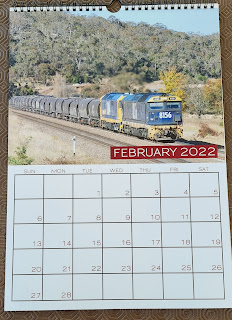
So it struck me that I have all these photos but I rarely look at them. They are filed away in digital storage and in archival slide boxes for some unknown future. At the same time I was thinking about my own photos, I realised I hadn't purchased my usual railway calendar for 2022. Coincidentally, I received an email from one of those photo book/stationery companies offering a discount on their range of products, including calendars, for 2022. That's when the penny dropped!

I ordered my calendar from Momento. The print and paper quality is excellent. Delivery was quick as well. Momento has software which you download and then it's just a matter of selecting a suitable template and adding images. Because I didn't have all my images organised, I made a quick hunt of some files on my PC and chose from there. I didn't manipulate any of the photos beforehand. One could do this using Photoshop or other digital imaging programs to really enhance the photo quality. Maybe next time.

I didn't spend too much time on this project but I am very pleased with the result. At least I now have 13 (including the front cover) of my photos out of the darkness that I can enjoy throughout the year. I thoroughly recommend putting your photos to good use in this way.

Friday, 24 December 2021

Christmas day a long, long time ago

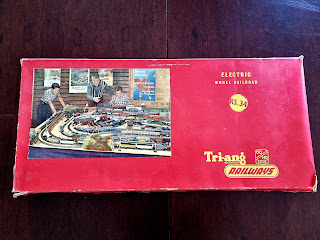
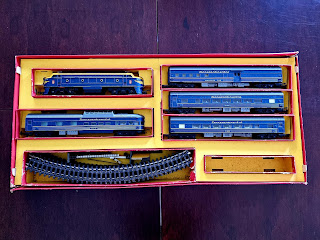
At this time of year I always reflect on my own childhood and the sense of wondrous expectation Christmas used to bring. And from one of those Christmases came a lifelong passion for model railways that has rarely diminshed over the (many) following years. On this particular Christmas Day I received my first train set - a Tri-ang Transcontinental passenger car set (RS.34).

Dad and I set up the track on the carpeted floor of the lounge room and had hours of fun just watching the train with its blue and gold passengar cars rotate around the oval of track (which I think at the time was called System 4). Having already been exposed to the real railways on some steam tours and the odd photographic expedition with my father, as well as dad's collection of "Railway Transportation" magazines, I imagined the train to be the wondrous Spirit of Progress in all its glory. It made no difference to me that the models were not great replicas, or that the scale and coarse track profile were not prototypically accurate. I let my imagination take over and that was it.

I added to that train set growing up but never really had a permanent layout while living with my parents (albeit my dad had a plan to have a lift up layout on pulleys above the car in the garage at one stage that never came to pass). 

In my teens I was exposed to Australian prototype model railways - firstly through the Australian Model Railroad Magazine (as it was called at the time) which I first saw at the local model railway shop (Micro Models in Hornsby). Not long after, I made my first Australian model railway purchases - a couple of MRC and Friedmont kits bought from Casula Hobbies in Casula. Joe was so impressed that my dad had driven me all the way from Hornsby that he gave us a discount. Joe from Casula Hobbies remains a wonderful advocate for the hobby and a genuine trailblazer supporting Australian prototype model railways. In fact, I just took advantage of his Christmas special 5% discount - thanks again, Joe!

Locos and rollingstock from Mansfield Hobbies and AR Kits soon entered my collection and the focus on NSW railway modelling took hold. But it wasn't until many years later that I built my first permanent layout and managed to actually run most of the equipment purchased from the preceding years. It was the time when if you saw something you wanted come onto the market, you snapped it up before it was gone forever! It's fair to say that I have more than enough in the collection nowadays.

Since then we have had a tremendous explosion of local manufacturers bringing in detailed Australian model railway locomotives, passenger cars and rollingstock from China over the past 20+ years, as well as locally made products. These manufacturers are well represented in my collection, being from Trax/Powerline, Austrains, Auscision, Anton's Trains, Bergs Hobbies, BGB and BGM, Casula Hobbies, Eureka Models, IDR Models, Lloyds Model Railways, On Track Models, Southern Rail Models, SDS, Trainorama, and many more.

I still have that first Tri-ang train set as the photos show. It doesn't have much use other than to bring back some wonderful childhood memories. Thanks to my father and mother for introducing the hobby of model railways to me at Christmas time all those years ago.

Thursday, 4 November 2021

History and the art of compromise

One of the fascinating aspects of model railways is establishing a sense of history. This is usually accomplished by setting a time and a place. However, if you read layout articles in any of the major model railway magazines, you will invariably come across the introductory "history" of the layout that sets both the time and place, but most importantly, the history and thus the rationale for the layout. 


The layout owner is providing an historical context from which the layout comes to life. Modeller's license is a broad registration of bending or recreating history to give credence to the model railway.  Indeed, creating a believable history (accurate or otherwise) is almost as important as creating the layout itself.

There are some layouts that have a very distinct and specific history, (including Jack Burgess and his Yosemite Valley layout, Tony Koester's Nickel Plate St. Louis Division, and Tony Wright's wonderful Little Bytham in rural Lincolnshire (check out Tony's book Modelling the East Coast Main Line in the British Railways Era). 

There are other layouts with a prototype history based on real railroads (such as the Rock Island Lines,  and Everard Junction) or fictitious railroads (such as Allen McClelland's Virginian and Ohio Railroad). In that broad category there are proto-freelancers and plain ol' freelancers. What unites them is a shared view of creating a history for their layouts encompassing time and place.

The combination of time and place has always been important to me which is why I love the historical context in model railway layout articles. Studying maps and researching towns and industries is great fun. I have taken considerable time and research to establish the historical bona fides of my US prototype layout set in southern Minnesota but which includes some significant "what ifs" just the same. That said, recent changes to my home layout have forced me to reconsider some of this history. 

For example, the new simplified layout has changed direction. The previous version had east to the left and west to the right (which therefore had some intrinsic problems) but now direction is reversed, with east to the right and west to the left. As a result, the traffic pattern has also changed. And, because the main line is much shorter with less towns, the sense of "going somewhere else" is somewhat reduced as a train has only three towns to traverse instead of seven.

All this has meant a slightly different story to the previous version of history I had so assiduously developed over time. At first, this irked me a lot. I had done all this research and now it was being compromised. But hang on - I'd already "compromised history" with my "what if" scenario. My layout is based on a "what if" the CNW had not abandoned a particular branchline and had actually maintained it until purchase by the DME in 1986. 

I'd already compromised history by extending my layout period from 1995-96 to 1995-2000. That's a five year gap in which a lot happened in the real world with consequences for my layout. CNW joined Union Pacific, and Burlington Northern and Santa Fe merged. There were also some locomotive lettering changes - DME became Dakota, Minnesota and Eastern. If I was modelling a later period, I'd have to include the addition of the Iowa, Chicago and Eastern (ICE) with the DME in 2002 allowing for a new combination of locomotives. I'd been running unit trains out of Marshall (MN) from the Minnesota Soy Co-operative (MSC) complex with Archer Daniel Midland (ADM) and MSC tank cars despite the fact that ADM didn't purchase MSC until 2002, albeit with a 30% stake in MSC in 1997. And Vera Sun (founded in 2001) with its ethanol facility at Aurora (SD) hadn't been built yet but I run a few of those cars as well.

So where does that leave things?

I think where this leads to is the fact that railway modelling is a set of compromises. Even prototype purists have had to compromise somewhat. No matter what, there are compromises. What is different, however, is to what extent is the compromise and does it make sense to both the layout builder and the operators? And it is here where the historical context for the layout becomes critical.

I confess that creating a believable history within the geography and economics of railroading in model form is one of the most encompassing aspects of the hobby for me. Perhaps it's more in the "thinking space" than the "doing space" (something that close railway modeller friends will chide me for), but it also gives me a greater sense of realism (in my mind) and purpose to what I am doing. And this is what adds to the enjoyment of model railways more than anything else.

How important is "history" to your layout?

Tuesday, 31 August 2021

Back in the saddle

Firstly, thanks to everyone for their kind words of encouragement after last month's post. It was very pleasing to receive such support and sage advice. As a result, I have made a number of changes to the layout (and continue to do so), removing the second deck and much of the overall complexity to make things much more achievable, albeit at the loss of a significant length of run. I took the advice of a number of people, as well as from this publication by noted model railway builder, Lance Mindheim.

I was initially going to give a book review (something one would expect from the armchair), but I'll just comment on a couple of points that were relevant to my situation. The first thing I had to change was what I had initially thought of as my vision for the layout.

Essentially, my vision was based on my experiences in the US visiting and operating on very large layouts (some exceedingly large by Australian standards) with lots of operators. These layouts had long runs, often double-decked, and in massive basements. They had lots of towns and industries and many were wonderfully scenicked and landscaped. Even some of the "smaller" model railroads had lots of operating potential, with regular operating sessions (well, before Covid-19 struck), and a regular crew of good mates to run trains with. Lastly, and I conveniently forgot about this, all of these layouts had many helpers in the construction and operation of their basement empires. 

For example, Stephen Priest's massive layout, the Santa Fe St. Louis Division (see Railroad Model Craftsman, April 2019), had regular mid-week sessions where ten to twenty modellers would turn up to work on the layout. Can you imagine that? Ten to twenty people each week coming over to help you build and scenic your layout! Of course, Stephen is a NMRA Master Model Railroader and so are some of his friends, but still, building a HUGE layout (50' x 78') required a LOT of work. All those helpers certainly increased the achievability of the layout within a shorter time frame than otherwise the case.

Clearly, all of the above circumstances did not translate to me. It was what I wanted and it was my vision for the future, but it was not realistic or achievable within the context of my situation.

As Clint Eastwood famously said, "A man's gotta know his limitations". And this also crosses over to time, ability, and capacity to construct a model railway given that all three have inherent limitations. In Lance Mindheim's book, he warns of being bogged down as the modeller becomes "engulfed and overwhelmed because they underestimated the magnitude of their dreams". Quite....

The other problem compounding the enormity of the task was the garage itself, not an ideal environment especially in winter. While I do have insulation in the roof with a ceiling, some draft prevention around the garage doors, and an Aldi reverse-cycle air conditioner that I think I have fixed for some reliability (RTFM....ahem), it takes a while to crank up the heat to work in the garage comfortably. Consequently, stepping into the garage for the odd 15-20 minutes of work rarely happened. In addition, all the garage tools and paraphenalia added to the visual clutter (along with the modelling clutter on my second deck) to give the room that air of utter despondency!

Lastly, sometimes we can be too clever by half. I had a good idea of the trains and sequencing I wanted to run and this involved a lot of trains and some yard complexities which I figured I could sort out without too much trouble. There were four hidden staging areas and while I have the cameras and a screen to deal with this, I was never fully confident it would actually work in practice without causing undue stress. That was one thing I should have remembered from operating on layouts in the US - it can be very stressful at times and this was, and is, a truly unpleasant feeling. Sure, the hidden staging could have been overcome with cameras and informative control panels, but was all this complexity and possible angst actually necessary? Was I trying to find solutions to problems I actually didn't need? The answer was a resounding yes. I have removed two of the four hidden staging yards with one more to go! The fourth staging area will remain, but no longer totally hidden. In addition, I simplified the main classification yard, going back to Google Earth to check on a similar classification yard on my prototype to make sure my simplified version was believable...and yes it was!

I could go on but I'll finish up now. Suffice to say, I have been spending more time on the layout on weekends and in the evenings than ever before. It is still cold at times but I am more prepared to set up the heating beforehand knowing that I will go into the garage and actually accomplish something instead of being stuck by the enormity of the task. Reducing the complexity of the layout, and making the layout more manageable and achievable within the accepted limitations, means more time and energy (both physical and electrical) to progress the layout for a more enjoyable outcome.

This blog isn't really about building my layout, but I think my experience might be of value to others who are considering building a large layout and who may also need some encouragement. So, thanks everybody.