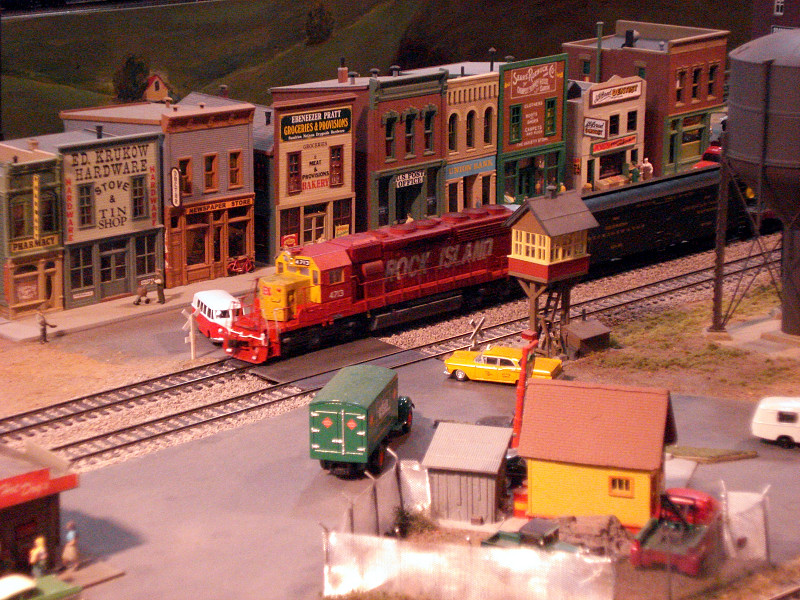
This afternoon I made the drive for a quick visit to the Bungendore Model Railway Exhibition. Bungendore is about 40km from home in Canberra. I didn't have a lot of spare time this weekend so I only had about an hour at the exhibition to have a good look around.
This was the first model railway exhibition in Bungendore, held at the multi-purpose hall of Bungendore Primary School. There were about fifteen layouts (HO and N scale) and about half a dozen commercial traders. It was a good balance for a relatively small exhibition.
Most of the layouts were exhibited by local Bungendore or Canberra railway modellers. The layouts included Crestwood, Eskbank, Little Austria, Nicholls Siding, NMRA (ACT Division) US layout, Sodor, Sydney Central, and the Canberra Monaro N scale Group's AusTrak modular layout. Springfield Junction (Hills Model Railway Society), South Creek (NSW N scale Group) and Strawberry Hills (Sydney N scale Model Railway Club) made the trip from Sydney.Yallah came from the Illawarra.
I have included a few photos from my short visit today.
The first two photos are from the Eskbank (circa. 1899) layout (HO scale). Eskbank is a real location near Lithgow (NSW) at the western foot of the Blue Mountains. The first photos shows (or should that be shews?) a short freight consist moving slowly through Eskbank station. Note that the freight car just behind the loco is a wagon hauling coal gas. The second photo shows a U105 on the turntable at Eskbank. The U105 Baldwin locomotive is based on a Roundhouse model (I think) and the turntable is by Fleischmann.
The next photo is from Ross Balderson's Sydney Central (N scale). The photo show the trams along Eddy Avenue, a common sight in 1958, the period in which the model typifies.
The next three photos show generic NSW locations on typical exhibition-style layouts (plenty of colour and movement). In order, the layouts are Crestwood (HO), Nicholls Siding (HO), and South Creek (N scale).
The last three photos are from the US-inspired Springfield Junction (HO) layout. I saw this layout previously at the Beecroft Exhibition a couple of months ago.This layout operates using NCE digital command control (DCC). Note the way in which the throttle sits when not in use on the layout.
Sunday, 17 October 2010
Tuesday, 5 October 2010
Sydney Model Railway Exhibition Report 2010
The Sydney Model Railway Exhibition is over for another year. The 2010 exhibition, the 48th, was another great show with plenty of layouts and commercial stands to keep everyone happy. Moreover, I spent almost all of Saturday talking to people which is testimony to the fact that the exhibition is a great social venue for the hobby. I made a second visit on Sunday to actually see the layouts and do a bit of shopping.
As I said in my previous post, there were about thirty layouts on show covering the majority of scales. The most common scale was HO scale followed by layouts in N scale (including the fabulous Sydney Central Station, and the Japanese Enoshima layout). Particular favourites for me included Eskbank (HO), Tarana (N), Time and Patience (HO), Waterfall (HO), and Wallerawang (HO). The Epping Club once again exhibited Brisbane Waters (HO) and this layout, still popular, must surely be Australia's most exhibited model railway layout over the years!
There was a display of live steam engines from the Western Districts Live Steamers, as well as a couple of G scale garden layouts. In O scale there was the wonderful Muskrat Ramble, and 4mm scale was represented by Bridport South Western layout. The exhibition is a pretty good indication of what the hobby has to offer; from the popular Lego City display and G scale garden railroading, to live steam, narrow gauge, and the traditional HO, 4mm, and N scales.
There were over 50 commercial trade stands (including scale and enthusiast associations). The major local manufacturers were all there, including Auscision, Austrains, Bergs, Eureka, On Track, Powerline (Train Hobby), Southern Rail, and Trainorama. Specialist suppliers such as Chucks Ballast, Kerroby, IDR and InFront Models were also there, as were retail shops such as Casula Hobbies, Gwydir Valley, Orient Express, and Traintasia, among others. The trade stands were certainly in the majority, something I have noticed more and more in recent times. In addition, there were a number of skill demonstrations, including white metal kit assembly and making trees.
I have included a few photos from the exhibition, but it never quite beats actually being there...
Eskbank features period modelling of the "early days" (1855-1930) of the New South Wales Government Railways and is based on the real Eskbank near Lithgow. This layout is scheduled to feature in the next issue of Australian Journal of Railway Modelling.
Waterfall debuted on the exhibition circuit at the Malkara Exhibition in Canberra in August. Since then, the layout has seen a massive increase in the number of trees plus many additional detail items. The layout is under continuous improvement and the lads from Illawarra should be very pleased with how the layout is progressing. Well done, chaps!
Ross Balderson's iconic N scale display of Sydney Central Station is a beautiful example of architectural modelling. The presentation of the exhibit is also superb. The public will have another chance to see the layout when it goes on display at the Bungendore Model Railway Exhibition on the 16th October.
Muskrat Ramble is a wonderful example of scenery modelling. While trains do meander through the forest, past the waterfront and out to the cottonfields, the main emphasis of this layout is the detailed scenery.
Wallerawang is a typical exhibition layout with a station and yard but the unique feature of this layout is the wonderful station building.
Bridport South Western is a 4mm scale layout based on the London South Western in the 1830s. A highlight of this display is the pre-recorded running commentary that gives a great explanation of both the features of the model and the prototype.
Museum Station is a HO scale representation of Museum Station, part of the Sydney city underground suburban network. With model railway manufacturers introducing a wide range of electric suburban and interurban sets, perhaps we will see more examples of suburban railroading in the future.
Finally, the last three images (below) show the highly colourful and detailed Japanese N scale layout, Enoshima. This layout has plenty of fast train action within a largely packed urban cityscape. In addition, a sample of Japanese pop music is displayed on the LCD screen in one of the tall buildings. The layout is a great example of colour, movement, and sound.
As I said in my previous post, there were about thirty layouts on show covering the majority of scales. The most common scale was HO scale followed by layouts in N scale (including the fabulous Sydney Central Station, and the Japanese Enoshima layout). Particular favourites for me included Eskbank (HO), Tarana (N), Time and Patience (HO), Waterfall (HO), and Wallerawang (HO). The Epping Club once again exhibited Brisbane Waters (HO) and this layout, still popular, must surely be Australia's most exhibited model railway layout over the years!
There was a display of live steam engines from the Western Districts Live Steamers, as well as a couple of G scale garden layouts. In O scale there was the wonderful Muskrat Ramble, and 4mm scale was represented by Bridport South Western layout. The exhibition is a pretty good indication of what the hobby has to offer; from the popular Lego City display and G scale garden railroading, to live steam, narrow gauge, and the traditional HO, 4mm, and N scales.
There were over 50 commercial trade stands (including scale and enthusiast associations). The major local manufacturers were all there, including Auscision, Austrains, Bergs, Eureka, On Track, Powerline (Train Hobby), Southern Rail, and Trainorama. Specialist suppliers such as Chucks Ballast, Kerroby, IDR and InFront Models were also there, as were retail shops such as Casula Hobbies, Gwydir Valley, Orient Express, and Traintasia, among others. The trade stands were certainly in the majority, something I have noticed more and more in recent times. In addition, there were a number of skill demonstrations, including white metal kit assembly and making trees.
I have included a few photos from the exhibition, but it never quite beats actually being there...
Eskbank features period modelling of the "early days" (1855-1930) of the New South Wales Government Railways and is based on the real Eskbank near Lithgow. This layout is scheduled to feature in the next issue of Australian Journal of Railway Modelling.
Waterfall debuted on the exhibition circuit at the Malkara Exhibition in Canberra in August. Since then, the layout has seen a massive increase in the number of trees plus many additional detail items. The layout is under continuous improvement and the lads from Illawarra should be very pleased with how the layout is progressing. Well done, chaps!
Ross Balderson's iconic N scale display of Sydney Central Station is a beautiful example of architectural modelling. The presentation of the exhibit is also superb. The public will have another chance to see the layout when it goes on display at the Bungendore Model Railway Exhibition on the 16th October.
Muskrat Ramble is a wonderful example of scenery modelling. While trains do meander through the forest, past the waterfront and out to the cottonfields, the main emphasis of this layout is the detailed scenery.
Wallerawang is a typical exhibition layout with a station and yard but the unique feature of this layout is the wonderful station building.
Bridport South Western is a 4mm scale layout based on the London South Western in the 1830s. A highlight of this display is the pre-recorded running commentary that gives a great explanation of both the features of the model and the prototype.
Museum Station is a HO scale representation of Museum Station, part of the Sydney city underground suburban network. With model railway manufacturers introducing a wide range of electric suburban and interurban sets, perhaps we will see more examples of suburban railroading in the future.
Finally, the last three images (below) show the highly colourful and detailed Japanese N scale layout, Enoshima. This layout has plenty of fast train action within a largely packed urban cityscape. In addition, a sample of Japanese pop music is displayed on the LCD screen in one of the tall buildings. The layout is a great example of colour, movement, and sound.
Friday, 1 October 2010
Sydney Model Railway Exhibition 2010
Tomorrow morning I will be driving from Canberra to Liverpool, Sydney, for the annual October long weekend Sydney Model Railway Exhibition. Since I am staying in Sydney tomorrow night, I'll be back at the exhibition on Sunday as well before driving home.
I have some advance information that tells me that there will be about 30 layouts and over 40 commercial stands. I must say that I have seen most of the layouts before; but then again, I do go to a fair number of exhibitions throughout the year!
Some of the layouts on show this weekend that I have enjoyed before include: Bridport South Western, Enoshima, Eskbank, Muskrat Ramble, Sydney Central Station, Time and Patience, and Waterfall. Muskrat Ramble is featured in the latest issue of Narrow Gauge Down Under (no relation), and Eskbank will be featured in the next issue of Australian Journal of Railway Modelling. And the excellent Waterfall layout will be having its next outing since it was first exhibited in "pristine" form at Canberra in August.
I look forward to the exhibition tomorrow and catching up with Sydney friends and the usual contingent of modellers from Canberra. See you there!
I have some advance information that tells me that there will be about 30 layouts and over 40 commercial stands. I must say that I have seen most of the layouts before; but then again, I do go to a fair number of exhibitions throughout the year!
Some of the layouts on show this weekend that I have enjoyed before include: Bridport South Western, Enoshima, Eskbank, Muskrat Ramble, Sydney Central Station, Time and Patience, and Waterfall. Muskrat Ramble is featured in the latest issue of Narrow Gauge Down Under (no relation), and Eskbank will be featured in the next issue of Australian Journal of Railway Modelling. And the excellent Waterfall layout will be having its next outing since it was first exhibited in "pristine" form at Canberra in August.
I look forward to the exhibition tomorrow and catching up with Sydney friends and the usual contingent of modellers from Canberra. See you there!
Wednesday, 29 September 2010
Adelaide layouts and NRM photos 2010
As I indicated in my previous post, I have a few photos to show from my trip to Adelaide for the Modelling the Railways of South Australia Convention.
The first two sets of photos show the two home layouts I managed to visit after the Convention. Both of these layouts featured (along with The Moping Branch layout) in the book "Recollections" by Kevin Kavanagh released last year at the Convention. The book gives a good insight into a handful of layouts owned and operated by like-minded individuals who have been part of the ABLO (Adelaide Branch Line Operators) group during the past forty years or so. The two layouts featured below still use a card operating system based on the ABLO method. The ABLO card system was featured in an article in the January 1977 issue of the Australian Model Railway Magazine (AMRM).
The first three photos shows the layout of Kev Kavanagh (not The Moping Branch Kev) that I was privileged to visit on the day after the Convention. The layout is the Huntingdale & Grange Railway. This layout was featured in the December 1997 issue of AMRM.
The next four photos shows the layout of Hugh Williams. This layout was moved in total from its former home in Belair to its new owner and new location - quite a move given the size of the layout and the complexity of the track plan. The layout runs around itself in three loops and each level is visible behind each other. As I said in the previous post, I did not find the visible layers distracting at all while I was operating my train. A description of the layout and a line diagram of the track plan are in the book "Recollections".
Finally, I have included a couple of photos from the National Railway Museum at Port Adelaide. The photos show, in order, a portrait of the front end of the SAR 930 class diesel; a shot of the Commonwealth Railways Budd car (that one is for Bob Stack), and the third photo is of a trio of LCL containers sitting in an open wagon (that's for Bob Gallagher).
I have already pencilled in some time away next year for the Convention plus a couple of extra days for "sightseeing". Keep a lookout for the 2011 dates that will be advised on the Modelling the Railways of South Australia Convention website.
The first two sets of photos show the two home layouts I managed to visit after the Convention. Both of these layouts featured (along with The Moping Branch layout) in the book "Recollections" by Kevin Kavanagh released last year at the Convention. The book gives a good insight into a handful of layouts owned and operated by like-minded individuals who have been part of the ABLO (Adelaide Branch Line Operators) group during the past forty years or so. The two layouts featured below still use a card operating system based on the ABLO method. The ABLO card system was featured in an article in the January 1977 issue of the Australian Model Railway Magazine (AMRM).
The first three photos shows the layout of Kev Kavanagh (not The Moping Branch Kev) that I was privileged to visit on the day after the Convention. The layout is the Huntingdale & Grange Railway. This layout was featured in the December 1997 issue of AMRM.
The next four photos shows the layout of Hugh Williams. This layout was moved in total from its former home in Belair to its new owner and new location - quite a move given the size of the layout and the complexity of the track plan. The layout runs around itself in three loops and each level is visible behind each other. As I said in the previous post, I did not find the visible layers distracting at all while I was operating my train. A description of the layout and a line diagram of the track plan are in the book "Recollections".
Finally, I have included a couple of photos from the National Railway Museum at Port Adelaide. The photos show, in order, a portrait of the front end of the SAR 930 class diesel; a shot of the Commonwealth Railways Budd car (that one is for Bob Stack), and the third photo is of a trio of LCL containers sitting in an open wagon (that's for Bob Gallagher).
I have already pencilled in some time away next year for the Convention plus a couple of extra days for "sightseeing". Keep a lookout for the 2011 dates that will be advised on the Modelling the Railways of South Australia Convention website.
Wednesday, 22 September 2010
SAR Convention 2010 Report
Sorry for the delay in reporting back on the Modelling the Railways of South Australia Convention held a couple of weekends ago in Adelaide.
The 2010 Convention was really great this year. We had some first class presentations, including a wonderful photo presentation and explanation of the famous Moping Branch layout. The Moping Branch layout was featured in a couple of AMRM articles well over 20 years ago. A DVD of the layout was also on sale for $20 and I was one of the lucky ones to buy a copy before they sold out on the day!
The other featured presentations included:
The 2010 Convention was the 15th and I have been going every year since 1998, missing only one Convention in that time. Once again, the annual Convention notes were a high quality product. I now have four thick volumes of truly exceptional historical articles and photographs dealing with both the South Australian Railways (SAR) and Commonwealth Railways (CR).
On the Sunday, the day after the Convention, I went to the National Rail Museum (formerly known as the Port Dock Railway Museum) at Port Adelaide. The Museum had a sale of railway memorabilia and train magazines in the morning. I bought a Working Timetable from the early 1970s.
Mid-morning saw me off to Kev Kavanagh's home to see his beautiful Huntingdale model railway. The layout is a two level point-to-point layout based on the SAR. When I download the photos from my camera I will put a couple up on the blog.
The afternoon saw me back at the National Railway Museum. I had a good look around, taking a few photos along the way. Bob Gallagher (former Managing Editor of AMRM) had asked me to track down and photograph a wooden LCL container at the Museum. Thankfully, I found it OK inside an SAR bogie open wagon with a couple of of the traditional steel LCL containers for company.
I took a couple of days leave this trip and on Monday (13th September) I drove up to Crystal Brook hoping to see plenty of train action. At Crystal Brook, some shunting was taking place at the grain silos; unfortunately using tractor power rather than loco power. As it turned out, the weather turned overcast so I didn't stay too long. I did see a Perth-Melbourne intermodal speed through Crystal Brook with a couple of QR locos on the front - a 6000 class and a LDP. I ended up getting a photo of the train at Snowtown. I returned to Adelaide via Clare before the weather really let loose with strong winds and a torrential downpour of rain.
That night I had been invited to an operating session of the Belair layout at the home of Hugh Williams. This layout was a multi-ringed layout featuring SAR and Victorian Railways (VR) prototypes. There were about seven operators on the layout, albeit I had a personal coach with me to help me run my timetabled set of trains (thanks, Steve). Photos to come shortly....
The two home layouts I visited, as was the Moping Branch, were multi-level and multi-track but without the double-deck configuration I mostly see in US model railroad magazines. All three layouts used a card operating system based on the system developed by the ABLO group from the 1960's-1970s. The three layouts looped at least twice and the multi-levels remained visible, even though each level was independent of each other in terms of the fictional geography of the layout. In that sense, they were similar in style to Bob Stack's South Coast Rail.
I didn't find the visible multi-levels at all distracting as I concentrated on running my individual trains around the layouts. I am now seriously looking at this option for my home layout since it gives the extra running length without taking up too much space and/or relying on space-hugging helixes to elevate tracks to the higher level.
All in all, I had a great time in Adelaide. Thank you one and all.
The 2010 Convention was really great this year. We had some first class presentations, including a wonderful photo presentation and explanation of the famous Moping Branch layout. The Moping Branch layout was featured in a couple of AMRM articles well over 20 years ago. A DVD of the layout was also on sale for $20 and I was one of the lucky ones to buy a copy before they sold out on the day!
The other featured presentations included:
- the 720 class steam locomotive
- the Wilmington line
- the Indian Pacific cars
- SAR models I've built by the mercurial Frank Kelly
- stepdown platforms
- building resin structure kits
The 2010 Convention was the 15th and I have been going every year since 1998, missing only one Convention in that time. Once again, the annual Convention notes were a high quality product. I now have four thick volumes of truly exceptional historical articles and photographs dealing with both the South Australian Railways (SAR) and Commonwealth Railways (CR).
On the Sunday, the day after the Convention, I went to the National Rail Museum (formerly known as the Port Dock Railway Museum) at Port Adelaide. The Museum had a sale of railway memorabilia and train magazines in the morning. I bought a Working Timetable from the early 1970s.
Mid-morning saw me off to Kev Kavanagh's home to see his beautiful Huntingdale model railway. The layout is a two level point-to-point layout based on the SAR. When I download the photos from my camera I will put a couple up on the blog.
The afternoon saw me back at the National Railway Museum. I had a good look around, taking a few photos along the way. Bob Gallagher (former Managing Editor of AMRM) had asked me to track down and photograph a wooden LCL container at the Museum. Thankfully, I found it OK inside an SAR bogie open wagon with a couple of of the traditional steel LCL containers for company.
I took a couple of days leave this trip and on Monday (13th September) I drove up to Crystal Brook hoping to see plenty of train action. At Crystal Brook, some shunting was taking place at the grain silos; unfortunately using tractor power rather than loco power. As it turned out, the weather turned overcast so I didn't stay too long. I did see a Perth-Melbourne intermodal speed through Crystal Brook with a couple of QR locos on the front - a 6000 class and a LDP. I ended up getting a photo of the train at Snowtown. I returned to Adelaide via Clare before the weather really let loose with strong winds and a torrential downpour of rain.
That night I had been invited to an operating session of the Belair layout at the home of Hugh Williams. This layout was a multi-ringed layout featuring SAR and Victorian Railways (VR) prototypes. There were about seven operators on the layout, albeit I had a personal coach with me to help me run my timetabled set of trains (thanks, Steve). Photos to come shortly....
The two home layouts I visited, as was the Moping Branch, were multi-level and multi-track but without the double-deck configuration I mostly see in US model railroad magazines. All three layouts used a card operating system based on the system developed by the ABLO group from the 1960's-1970s. The three layouts looped at least twice and the multi-levels remained visible, even though each level was independent of each other in terms of the fictional geography of the layout. In that sense, they were similar in style to Bob Stack's South Coast Rail.
I didn't find the visible multi-levels at all distracting as I concentrated on running my individual trains around the layouts. I am now seriously looking at this option for my home layout since it gives the extra running length without taking up too much space and/or relying on space-hugging helixes to elevate tracks to the higher level.
All in all, I had a great time in Adelaide. Thank you one and all.
Thursday, 9 September 2010
Modelling the Railways of South Australia Convention 2010
This Saturday I will be attending the Modelling the Railways of South Australia Convention. I have been to several over the years and always have a great time. And the presentation notes are second to none!
I am actually flying down to Adelaide tomorrow morning for a work seminar. I will be then spending the next few days in Adelaide at the Convention on Saturday, visiiting the National Rail Museum and a couple of layouts on Sunday, and then looking for opportunities to take some photos of 1:1 rail action in the Adelaide environs after that. I might have a look around some of the Adelaide hobby shops as well, including Orient Express Model Railway Shop in suburban Unley where I want to check out the Zimo system of DCC.
I am really looking forward to the trip and will report back next week
I am actually flying down to Adelaide tomorrow morning for a work seminar. I will be then spending the next few days in Adelaide at the Convention on Saturday, visiiting the National Rail Museum and a couple of layouts on Sunday, and then looking for opportunities to take some photos of 1:1 rail action in the Adelaide environs after that. I might have a look around some of the Adelaide hobby shops as well, including Orient Express Model Railway Shop in suburban Unley where I want to check out the Zimo system of DCC.
I am really looking forward to the trip and will report back next week
Sunday, 22 August 2010
Caulfield Model Railway Exhibition 2010
The Caulfield Model Railway Exhibition is over for another year. This year marked the 40th anniversary of the exhibition run by the AMRA Victorian Branch. I went to the exhibition yesterday, flying down from Canberra, and had a great time.
There were 25 layouts out of 65 stands. The plethora of commercial stands at the one location made it very easy for shoppers to part with their money! Of most interest, were the Austrains Victorian Railways 4 wheelers (B, I, and IA) which sold out just after lunch on Saturday. I understand more packs were made available today from an express overnight shipment from Sydney. Austrains were also selling their newly arrived NR in Southern Spirit green and white livery.
A number of pilot models were on display at the Caulfield exhibition. Auscision had their forthcoming Victorian Railways GY 4 wheeler. Trainorama displayed their Commonwealth Railways GM and NSWR 48 class diesel locomotives. Elsewhere, the NSWR 48 class diesel (in four different versions) was on display from Powerline. Meanwhile, Eureka was also at the exhibition, fielding a number of inquiries about the continuing delays for the VR R and K class steam locos and the NSWR 40 class diesel. Ron Cunningham advised that Eureka were going to use a new manufacturer since they had been cut by Sandakan (Kader). However, I am not sure if the models previously announced have been cut by Sandakan or not. Perhaps Ron will explain more in due course on his website.
Of the layouts, the AMRA Victorian Branch were exhibiting their HO scale US prototype layout Wills Street for the last time. The layout was being offered for sale. The photo belows shows a BN&Q train heading through a rather deserted looking yard on Wills Street.
Another large US layout on display, and exhibited at the show last year, was from Glenn Brooks and the Latrobe Valley Model Railway Association featuring western railroad action based on the Union Pacific and Rio Grande. This layout was very impressive, both in terms of physical size and plenty of continuous train action.
The Coffs Harbour (NSW) Railway Modellers Group came all the way south of the border to display their large US-styled HO scale layout. The layout scenery and buildings are based on the US scene, but at different times during the day trains from the US, NSW and Victorian Railways all get a turn showing their wares around the layout under digital command control (DCC). The photo belows show US steam action with a long train of reefers.
VR-based layouts in HO scale included Benalta, Broadford, Coliban Valley, End of the line, and Tyobic. I hadn't seen Tyobic before and it followed the tradition of a VR country through-station with a yard. The layout had a split backscene, like End of the line, that sent a train through to the fiddleyard through a gap in the backscene just passed a nicely modelled railway crossing. The next two photos illustrate Tyobic.
In N scale, layouts on show included Georgetown (UK), Springhill Yellow Pine Division (US), and Enoshima (Japanese). I think Enoshima was being displayed at Caulfield for the first time and certainly drew in the crowds.
There were also two very different but very interesting layouts on display. The first, was the HO scale Howjadoit, that showed a small compact layout under different stages of construction. This display was a great demonstration of how a layout is constructed, something we need to show to the public more often.
The second interesting layout was the Oe scale Pierreville. Pierreville depicts a French railroad station where narrow and standard gauge tracks meet to transfer passengers between the systems. A nice feature of the layout was the fernicular railroad at the front. And I was quite intrigued by the system of getting trains on and off the layout (see photo below).
As well as enjoying the layouts and commercial stands, I caught up with several railway modellers that I know very well; most from Canberra or Sydney strangely enough. All in all, it was a great day out.
There were 25 layouts out of 65 stands. The plethora of commercial stands at the one location made it very easy for shoppers to part with their money! Of most interest, were the Austrains Victorian Railways 4 wheelers (B, I, and IA) which sold out just after lunch on Saturday. I understand more packs were made available today from an express overnight shipment from Sydney. Austrains were also selling their newly arrived NR in Southern Spirit green and white livery.
A number of pilot models were on display at the Caulfield exhibition. Auscision had their forthcoming Victorian Railways GY 4 wheeler. Trainorama displayed their Commonwealth Railways GM and NSWR 48 class diesel locomotives. Elsewhere, the NSWR 48 class diesel (in four different versions) was on display from Powerline. Meanwhile, Eureka was also at the exhibition, fielding a number of inquiries about the continuing delays for the VR R and K class steam locos and the NSWR 40 class diesel. Ron Cunningham advised that Eureka were going to use a new manufacturer since they had been cut by Sandakan (Kader). However, I am not sure if the models previously announced have been cut by Sandakan or not. Perhaps Ron will explain more in due course on his website.
Of the layouts, the AMRA Victorian Branch were exhibiting their HO scale US prototype layout Wills Street for the last time. The layout was being offered for sale. The photo belows shows a BN&Q train heading through a rather deserted looking yard on Wills Street.
Another large US layout on display, and exhibited at the show last year, was from Glenn Brooks and the Latrobe Valley Model Railway Association featuring western railroad action based on the Union Pacific and Rio Grande. This layout was very impressive, both in terms of physical size and plenty of continuous train action.
The Coffs Harbour (NSW) Railway Modellers Group came all the way south of the border to display their large US-styled HO scale layout. The layout scenery and buildings are based on the US scene, but at different times during the day trains from the US, NSW and Victorian Railways all get a turn showing their wares around the layout under digital command control (DCC). The photo belows show US steam action with a long train of reefers.
VR-based layouts in HO scale included Benalta, Broadford, Coliban Valley, End of the line, and Tyobic. I hadn't seen Tyobic before and it followed the tradition of a VR country through-station with a yard. The layout had a split backscene, like End of the line, that sent a train through to the fiddleyard through a gap in the backscene just passed a nicely modelled railway crossing. The next two photos illustrate Tyobic.
In N scale, layouts on show included Georgetown (UK), Springhill Yellow Pine Division (US), and Enoshima (Japanese). I think Enoshima was being displayed at Caulfield for the first time and certainly drew in the crowds.
There were also two very different but very interesting layouts on display. The first, was the HO scale Howjadoit, that showed a small compact layout under different stages of construction. This display was a great demonstration of how a layout is constructed, something we need to show to the public more often.
The second interesting layout was the Oe scale Pierreville. Pierreville depicts a French railroad station where narrow and standard gauge tracks meet to transfer passengers between the systems. A nice feature of the layout was the fernicular railroad at the front. And I was quite intrigued by the system of getting trains on and off the layout (see photo below).
As well as enjoying the layouts and commercial stands, I caught up with several railway modellers that I know very well; most from Canberra or Sydney strangely enough. All in all, it was a great day out.
Subscribe to:
Posts (Atom)