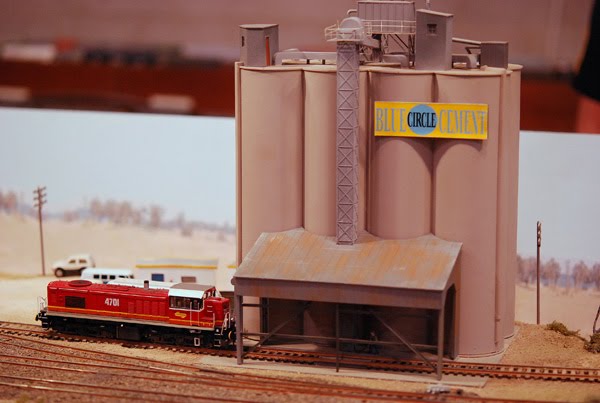
On the 1st May, I flew from Canberra to Brisbane with a friend (David Low) to attend the Brisbane Model Train Show. The flight was uneventful, although David was particularly impressed by the QANTAS breakfast (he obviously needs to get out more!).
Upon arrival at Brisbane airport, we raced over and caught the Skytrain which would take us to Fortitude Valley railway station. Luckily for me, David "shouted" me the train fare - a whopping $56 return fare for the two of us (thanks, David). We got out of the train at Fortitude Valley station, walked through the small above-station shopping centre, and then outside for the five minute walk to the RNA Showgrounds and the train show.
The train show was held in two large pavilions (one pavilion less than when I last attended a couple of years ago). The outer ring within the pavilions was where the commercial traders were mostly located and included ARHS (QLD), Auscision, Austral Modelcraft, Christmas Every Day, Chucks Ballast, Eureka Models, Forest Miniatures, Gwydir Valley Models, Horizon Hobbies, Modular Train Tables, Remote Control Systems, Train World, and Wuiske Models, among others.
Inside the commercial ring were the layouts. The layouts were generally representative of what you'd see at most model railway exhibitions, albeit with an emphasis on layouts of most appeal to the general public.
I was, however, very impressed by a Great Western Railway (GWR) branch terminus layout called Princetown, based on the prototype Princetown branch line through Dartmoor in England. The model was to 00 scale (1:76). I really liked the atmosphere created by some excellent scenery and layout composition, with a sense of spaciousness and without any unsightly clutter. I spent quite a lot of time enjoying the fine scenic detail and talking with the operators (who, oddly enough, were both keen on electricity and wiring layouts - a rare pair indeed!). The station and associated buildings were very nicely done. The GWR tank engine saw plenty of duty ferrying passengers back and forth throughout the day (see photo below).
Another excellent layout was the small Quinton River layout (actually called Beauaraba Siding) that was built in 00 scale (rather unusual for Australian "prototype" layouts) and based on an Australian theme. This layout, whilst compact, had some fine scenery and buildings on display. Of special interest to me were the "invisible" stainless steel "Alex Jackson" type of couplings which worked a treat. These couplings are popular in the UK and I can see why - unobtrusive, and very effective coupling and uncoupling of wagons. The layout featured a very nice trestle which is illustrated below.
I also enjoyed the Queensland Railways (QR) S scale (1:64) Rosevale layout, which I had seen at the Brisbane Exhibition a couple of years ago. Rosevale is based on the south-east Division of the QR and set in the 1940-1960s time frame. I especially liked the buildings on this layout, particularly the pub (see photo below). The pub was based on the Railway Hotel at Imbil. My only "complaint" with this layout was that the trains seemed to be running too fast, but perhaps in S scale things just seem that way....
The Running Creek/West Goodna layout was another Queensland prototype layout in S scale. The locale is the Goodna and Redbank area in the Brisbane suburbs. However, the layout actually resides in Sydney. The layout was being exhibited for the last time. A photo of a diesel railcar crossing the steel bridge and approaching Goodna Station is in the photo below.
Of interest, was the layout called Freestone (photo below). This layout was another QR layout, this time based on the town of Freestone about 20kms east of Warwick in Queensland. The layout had a large curved backscene on which a suitable series of photos had been glued. Talking to the builder of the layout, getting the photos to stick was particularly challenging but photographic paper (?) and PVA did the trick!
Another layout at which I spent some time, was Brendale. Brendale was an HO scale Australian layout, with the occasional running of some US prototype trains as well. I had a good chat here about the merits of DCC (digital command control) and the NCE system in particular. The Brendale operators I spoke with were all very happy with the NCE system.
And speaking of DCC and curved backdrops, the Coffs Harbour Modellers modular layout was a showcase exhibit with superb lighting, scenery, and outstanding controlled running of the trains. I even spied a special guest operating the layout on Saturday morning - an office-bearer of the NMRA Australasian Region, Master Model Railroader (MMR), and DCC expert from the Central Coast of NSW.... I have seen this layout a few times now and never get tired of watching the trains roll by in such a well presented display.
The day passed quickly - looking at layouts, chatting to people we knew already and those we got to know, buying the odd item or two, and generally having a good time.
I especially want to commend the catering staff (called "Pink", from memory) who managed the food and drink demands of the crowd exceedingly well. They were well organised, well staffed, and flexible enough to take payment for small items without having to queue at the two registers at the end of the line. Well done!
Just before closing time at 5pm, David and I headed back to the train station and then to the airport. David enjoyed another QANTAS meal on the way home and we arrived back in Canberra around 8.30pm - the end of an entertaining day out.
Tuesday, 11 May 2010
Thursday, 6 May 2010
New Zealand Model Railway Convention - addendum
I want to finish off my description of the New Zealand Model Railway Convention by thanking the organisers of the event and the individuals who gave presentations and clinics. I also want to thank the people who displayed their layouts in the hall at the Convention and the people who displayed their home layouts on the layout tours. Finally, I want to say that I thoroughly enjoyed the conversations and hospitality of all the people I met and chatted to at the Convention.
The Convention was a great success, but there was more. Whilst there were no official layout tours on Monday 5th April, since the Convention was over, some local modellers gave times for an open house during the day.
I was exceedingly lucky to get to the home of Peter Ross, with barely a minute to spare, on my way home late in the afternoon from a day trip to Akaroa. Peter's layout, Amberley, is an S scale (1:64) work-in-progress based on the line between Amberley and Waipara, not too far north of Christchurch, and set in the 1950s. Peter was kind enough to invite me in and spend time talking with me about the layout well past the open house closing time. Thank you Peter - and what a superb layout!
Until next time....
The Convention was a great success, but there was more. Whilst there were no official layout tours on Monday 5th April, since the Convention was over, some local modellers gave times for an open house during the day.
I was exceedingly lucky to get to the home of Peter Ross, with barely a minute to spare, on my way home late in the afternoon from a day trip to Akaroa. Peter's layout, Amberley, is an S scale (1:64) work-in-progress based on the line between Amberley and Waipara, not too far north of Christchurch, and set in the 1950s. Peter was kind enough to invite me in and spend time talking with me about the layout well past the open house closing time. Thank you Peter - and what a superb layout!
Until next time....
Wednesday, 5 May 2010
New Zealand Model Railway Convention - Part 3
The third day of the New Zealand Model Railway Convention in Christchurch was Sunday 4th April. The weather had turned cold and overcast which was a pity since the afternoon activity included a trip to Ferrymead Heritage Park and some 1:1 steam train action. More on that later.
The morning clinics included "Freelance modelling", "Desert scenery", "Image manipulation", and "NZ scenery". I went to the clinic on New Zealand scenery and I was not disappointed. Barry Fitzgerald and John Dudson gave a great presentation on making and displaying some typical New Zealand trees and vegetation. Referring to my notes, I recorded the following dot points:
The second session of clinics on Sunday morning included "Track matters" with Iain Rice, "Modelling in the garden", Adapting RTR locos", and "Operation NZ style". I attended this latter clinic on model railway layout operation by Trevor James. Trevor based his talk on his own S scale NZR prototype layout, currently under the moniker of "My layout"! Trevor introduced his (absolutely beautiful) layout with a track plan and photos, based on a fictional railway line between Auckland and Wellington (on the North Island). The track plan looks like a figure eight in the middle of a surrounding single main line and featuring two big towns (Waimarino and Tipapa Junction) and end points (Auckland and Wellington) as off-scene staging.
Trevor explained how he applied the common US model railway operation method of cards and waybills. The planning process and use of an operating system went something like this:


The last photo shows my NZ compatriots (the three chaps at the back) with whom I enjoyed a pleasant Sunday afternoon visiting home layouts and the wonderful Ferrymead Heritage Park. Thank you, one and all.
The morning clinics included "Freelance modelling", "Desert scenery", "Image manipulation", and "NZ scenery". I went to the clinic on New Zealand scenery and I was not disappointed. Barry Fitzgerald and John Dudson gave a great presentation on making and displaying some typical New Zealand trees and vegetation. Referring to my notes, I recorded the following dot points:
- look for particular motifs specific to the location you're modelling - helps to identify the location and give credibility to the scene - but motifs need to complement each other
- look for typical scenery and the familiarity of everyday life
- study the local architecture and apply to your modelling
- "detail is not overcrowding"
- provide for lineside interest (e.g. cameo scenes)
- use paper or thin cardboard (the suggested paper thickness was 80-85 gsm) to cut out a round-shaped disc of a size suitable for your cabbage tree foliage in your scale (S scale in this example)
- divide into quadrants in order to ensure even cuts around the disc to create "leaves"
- use scissors for the cutting (be careful not to cut through the centre or you won't have a disc anymore, but only part of a disc)
- put a pin through the centre (hence the "paper star" look)
- fold the "leaves" back and repeat process with more discs to build up layers of foliage until you have sufficient for your tree head
- you can add a lower fringe of grey paper "leaves" to represent dead or dried fronds
- select a suitable twig for the trunk and secure the "paper stars" head using PVA glue
- add additional fronds with green paper to the top using the same paper star method
- tease out the "leaves" or fronds to match the shape of the real-life cabbage trees
- paint paper stars shades of green or brown or yellow as appropriate
- add cabbage trees together in clumps on your layout
- build scenery on the layout from the ground up
- look for colour, texture, and variety (e.g. at every step you have a colour option)
- static grass is a good scenery method but use different shades of scenery flock
- important to blend colours to overcome the "same look" (a suggestion was to make up a colour chart of colour shades, particularly in the green and brown colour ranges)
- use rock moulds for modelling rock outcrops but pay attention to colour shades (recommend using Woodland Scenics colour range of paints)
- for concrete, "Tradeset 45" plaster recommended (sets in 45 minutes)
The second session of clinics on Sunday morning included "Track matters" with Iain Rice, "Modelling in the garden", Adapting RTR locos", and "Operation NZ style". I attended this latter clinic on model railway layout operation by Trevor James. Trevor based his talk on his own S scale NZR prototype layout, currently under the moniker of "My layout"! Trevor introduced his (absolutely beautiful) layout with a track plan and photos, based on a fictional railway line between Auckland and Wellington (on the North Island). The track plan looks like a figure eight in the middle of a surrounding single main line and featuring two big towns (Waimarino and Tipapa Junction) and end points (Auckland and Wellington) as off-scene staging.
Trevor explained how he applied the common US model railway operation method of cards and waybills. The planning process and use of an operating system went something like this:
- a point-to-point layout with two main intermediate towns towns, a couple of smaller settlements, and off-scene staging at both ends representing Auckland and Wellington
- a "wish list" determined key features on the layout (e.g. a wharf scene, bridges, farming, a swamp, industries, etc.)
- it was also important to give the layout a reason-for-being (e.g. traffic generation)
- establish appropriate industries and position on the layout
- design a timetable for trains on the layout ( time a locomotive as it runs around the layout and get times between stations; then using a train in each direction, build up a sequence of trains and times)
- establish type of train (express goods, etc.) and position in the timetable
- trial and error will help set an acceptable timetable from which to work from
- further detail can be added to include instructions on what to do at particular locations throughout the layout, taking into account other trains that might also be around (this layout operates one train in each direction with single line running)
- draw up work orders for each train, based on the type of wagons you have, the industries to serve, and the timetable
- from what I recall, the information was initially put into Microsoft Excel
- later, Trevor experimented with a computerised car card system called ShipIt
- ShipIt requires lists of rolling stock, locomotives, guards vans, trains, towns, shippers, products, consignees, etc.
- inputing all the necessary information into ShipIt was tedious and repetitive but Trevor said he would persevere!
- the conclusion of the talk was that creating a focus on operation was a realistic and enjoyable way to run trains on his layout
The last photo shows my NZ compatriots (the three chaps at the back) with whom I enjoyed a pleasant Sunday afternoon visiting home layouts and the wonderful Ferrymead Heritage Park. Thank you, one and all.
Labels:
Ferrymead,
Model railway conventions,
NZMRC,
Operations,
Planning,
Scenery
Tuesday, 4 May 2010
New Zealand Model Railway Convention - Part 2
Well, I'd better catch up with my report of the New Zealand Model Railway Convention from Christchurch at Easter (a few weeks ago now).
Day 2 was on Saturday 3rd April. The morning started with a number of concurrent clinics. The clinics included "modelling with CAD" and "NZ scenery". I went to the clinic on layout design by Iain Rice. This presentation followed on from Iain's presentation the previous day. I made some notes during the session in my usual dot point format which I will use here.
Layout design:
The main learning point for me was to look for daylight fluorescent tubes rated at 4200-4800K. Fluorescent tubes still offer better quality lighting for the money than alternatives (such as halogen or LEDs for room and layout lighting). Interestingly, Iain Rice recommended "cool white" lights at 4200K as well.
The second half of the day was spent on a layout tour. I saw layouts at five different homes in the north Christchurch area. The five layouts included three English, three US, and one NZR 1:64 (S scale) layout. And if you can add up, let me explain that a couple of the homes had more than one layout! Scales represented included N, HO, OO, S, and G scale garden railroading.
I really appreciated the time the layout owners gave to host the tour, provide information and respond to questions, and for their obvious delight in running trains! And thanks to our driver who took four of us around in his car. The afternoon was very enjoyable indeed.
The next blog posting will have Day 3 and some photos...stay tuned!
Day 2 was on Saturday 3rd April. The morning started with a number of concurrent clinics. The clinics included "modelling with CAD" and "NZ scenery". I went to the clinic on layout design by Iain Rice. This presentation followed on from Iain's presentation the previous day. I made some notes during the session in my usual dot point format which I will use here.
Layout design:
- design for realism and visual effect
- take a natural viewpoint (the way the layout will be viewed compared to how we view the prototype - the two are not the same)
- design with consistency when it comes to standards and quality (without a consistent display, variation to standards and quality become obvious and detract from the display)
- accurate observation of the prototype and layout are critical, especially vegetation
- use natural colours - colour intensity recedes with distance; restrained colours more appropriate than stark, bright colours; requires superb observation and translation to model; and backdrops are important to finish off scenes
- Need to look at the combined relationship between layout height, viewpoint & backscene
- Need to pin down the horizon. In real life, the horizon is the eye level to the edge of the visible earth. Therefore, we need to account for the horizon on our model the same way, paying attention to the position of the skyline above (hills) or below (valleys) the horizon.
- cut out distractions and focus attention on the layout
- give the impression of distance and depth to a layout
- establishes the horizon (viewing perspective)
- contains the scene
- complements the model display
- layout lighting enhances the way a layout is observed by the viewer
- lighting affects the way colour on the layout is perceived (i.e. prototype v. model colours)
- light at back of scene to kill off shadows from light at the front of the display
- need for the right balance between the position of vertical and horizontal scenic elements
- needs to be visually appealing
- suggests the use of view blocks to focus a viewer's attention in order to showcase a particular scene or to "discourage" the close examination of a scene or scenic element. Thus, view blocks can direct a view or block a view.
- the span of vision for humans is 3' (36 inches) for a view 4' 6" (54 inches) wide - that's what my notes say!
- visual compression - not always possible to reduce a scenic element (e.g. a building) to an exact scale reduction because the object is often too large for the available space. Or it may not look right on the layout, irrespective of what the 1:1 scale might suggest. In these situations, try compressing the object proportionately by 80-90% and then make to scale (i.e. reduce the proportion of the actual object to be scaled for modelling purposes).
- perspective sketching is helpful (and Iain is quite skilled in this type of art)
- a "planning model" may help visualise your plan. The idea would be to do mock-ups, either in the same scale as your layout or smaller to check positioning and whether it looks right
- establish visual balance for enhanced composition
The main learning point for me was to look for daylight fluorescent tubes rated at 4200-4800K. Fluorescent tubes still offer better quality lighting for the money than alternatives (such as halogen or LEDs for room and layout lighting). Interestingly, Iain Rice recommended "cool white" lights at 4200K as well.
The second half of the day was spent on a layout tour. I saw layouts at five different homes in the north Christchurch area. The five layouts included three English, three US, and one NZR 1:64 (S scale) layout. And if you can add up, let me explain that a couple of the homes had more than one layout! Scales represented included N, HO, OO, S, and G scale garden railroading.
I really appreciated the time the layout owners gave to host the tour, provide information and respond to questions, and for their obvious delight in running trains! And thanks to our driver who took four of us around in his car. The afternoon was very enjoyable indeed.
The next blog posting will have Day 3 and some photos...stay tuned!
Labels:
Lighting,
Model railway conventions,
NZMRC,
Planning
Monday, 19 April 2010
New Zealand Model Railway Convention - Part 1
A couple of weeks ago over the Easter weekend, I attended the New Zealand Model Railway Convention in Christchurch. The convention was held at St Andrews College not far from the centre of town. The international guest speaker was Iain Rice from the UK.
Iain was certainly well used by the convention organisers. He spoke on all three days of the convention and visited many home layouts open for layout tours over the weekend. On the first day of the convention (Friday 2nd April), Iain spoke for almost two hours (with a short intermission) about his experiences with model railway layouts over the past 50-odd years (wow, is it really that long?). Iain's presentation was accompanied by some great layout photos from most of his layouts over that time and shown as Powerpoint slides. But this was certainly NOT death by Powerpoint - the images illustrated what Iain had to say perfectly.
Iain started off by telling us about some of his early layouts (e.g. East Suffolk Light, Tregarrick, Woolverstone, and Leintwardine which was built for the Model Railway Journal Show in 1991). Of particular interest to me was the thinking behind each of his layouts, and why some things worked and some things didn't. Iain also enjoyed describing the pros and cons of building white metal locomotive kits from a range of manufacturers in the UK; some harder to put together than others! The upshot is that experience is indeed a good teacher.
One of Iain's more recent model railway layouts is the diorama-like Trerice that depicts the china clay industry in North Cornwall. The layout, in P4, was initially only 6' 7'' long. Iain has since redone parts of the layout to increase operational interest. Trerice is "based on the same convenient fiction that spawned Tregarrick - a mixture of Bodmin and Wadebridge and Cornwall Minerals with a touch of North Devon and Cornwall Junction thrown in". I really liked the way Iain fictionalised a believable history on which to base his model railway; yet selecting practical and personally preferred aspects for the model that he wanted to bring to the layout. The blending of history and fiction for constructing context around a model railway layout seemed to have come naturally to Iain (perhaps a reflection of his theatrical side) which is rather a nice compromise really.
Iain also explained how he displays his exhibition layouts at model railway shows. To get a layout up to eye level for adults (about 58-odd inches if I remember correctly), he stands his layout on a portable table! All in all, it was a very informative and entertaining session.
On the Friday I also went to a presentation on weathering by Stan Agar and a workshop session with a number of demonstrations (the three from five offerings I went to were figure painting, custom decals, and building turnouts). The key message from the presentation on weathering was to refer to the prototype for good examples from which to copy or take ideas from. Stan uses a rather high 40psi for airbrushing, but also favours hand painting a mix of paint and powders for a good "grunge" look and feel. Humbrol enamel paint No.29 was recommended for washes, as was alkyld paint for relatively fast drying (2 days) applications.
The afternoon session concluded with a presentation of digital "slides" of Eric Brooman's famous Utah Belt model railway. The take-home from that presentation included the following:
1) avoid clutter and too many structures on the layout
2) produce typical scenery rather than unique (more believable)
3) staging is paramount
4) design for prototype operation
5) narrow shelves are effective with good backdrops to give depth of field
And in between the sessions there was time to chat and look at the layouts on display in the main hall. The people at the convention were exceptionally friendly and helpful - thank you, I really appreciated it.
I have included a couple of layout photos to whet your appetite for the next (belated) instalment.
The first three photos are taken of the large modular TALMR layout (NZR, 1:64 scale). David Low would certainly be happy with the buildings on this layout - superb stuff!


The next two photos are from the S scale (1:64) NZR layout, Arauatu.


Finally, there was a model competition at the convention. My favourite was this diorama of a New Zealand factory scene built by Mark Dalrymple.
Iain was certainly well used by the convention organisers. He spoke on all three days of the convention and visited many home layouts open for layout tours over the weekend. On the first day of the convention (Friday 2nd April), Iain spoke for almost two hours (with a short intermission) about his experiences with model railway layouts over the past 50-odd years (wow, is it really that long?). Iain's presentation was accompanied by some great layout photos from most of his layouts over that time and shown as Powerpoint slides. But this was certainly NOT death by Powerpoint - the images illustrated what Iain had to say perfectly.
Iain started off by telling us about some of his early layouts (e.g. East Suffolk Light, Tregarrick, Woolverstone, and Leintwardine which was built for the Model Railway Journal Show in 1991). Of particular interest to me was the thinking behind each of his layouts, and why some things worked and some things didn't. Iain also enjoyed describing the pros and cons of building white metal locomotive kits from a range of manufacturers in the UK; some harder to put together than others! The upshot is that experience is indeed a good teacher.
One of Iain's more recent model railway layouts is the diorama-like Trerice that depicts the china clay industry in North Cornwall. The layout, in P4, was initially only 6' 7'' long. Iain has since redone parts of the layout to increase operational interest. Trerice is "based on the same convenient fiction that spawned Tregarrick - a mixture of Bodmin and Wadebridge and Cornwall Minerals with a touch of North Devon and Cornwall Junction thrown in". I really liked the way Iain fictionalised a believable history on which to base his model railway; yet selecting practical and personally preferred aspects for the model that he wanted to bring to the layout. The blending of history and fiction for constructing context around a model railway layout seemed to have come naturally to Iain (perhaps a reflection of his theatrical side) which is rather a nice compromise really.
Iain also explained how he displays his exhibition layouts at model railway shows. To get a layout up to eye level for adults (about 58-odd inches if I remember correctly), he stands his layout on a portable table! All in all, it was a very informative and entertaining session.
On the Friday I also went to a presentation on weathering by Stan Agar and a workshop session with a number of demonstrations (the three from five offerings I went to were figure painting, custom decals, and building turnouts). The key message from the presentation on weathering was to refer to the prototype for good examples from which to copy or take ideas from. Stan uses a rather high 40psi for airbrushing, but also favours hand painting a mix of paint and powders for a good "grunge" look and feel. Humbrol enamel paint No.29 was recommended for washes, as was alkyld paint for relatively fast drying (2 days) applications.
The afternoon session concluded with a presentation of digital "slides" of Eric Brooman's famous Utah Belt model railway. The take-home from that presentation included the following:
1) avoid clutter and too many structures on the layout
2) produce typical scenery rather than unique (more believable)
3) staging is paramount
4) design for prototype operation
5) narrow shelves are effective with good backdrops to give depth of field
And in between the sessions there was time to chat and look at the layouts on display in the main hall. The people at the convention were exceptionally friendly and helpful - thank you, I really appreciated it.
I have included a couple of layout photos to whet your appetite for the next (belated) instalment.
The first three photos are taken of the large modular TALMR layout (NZR, 1:64 scale). David Low would certainly be happy with the buildings on this layout - superb stuff!


The next two photos are from the S scale (1:64) NZR layout, Arauatu.


Finally, there was a model competition at the convention. My favourite was this diorama of a New Zealand factory scene built by Mark Dalrymple.
Sunday, 28 March 2010
Canberra Exhibition report 2010
I attended the Canberra Model Railway Expo yesterday and today. The exhibition was located this year at Kaleen High School in the northern Canberra suburb of Kaleen.
The exhibition used the hall, a stage, and some other general purpose rooms for the layouts and commercial stands. At first glance, it looked a little confusing with the all the rooms and the different pathways to and from the rooms (the exhibition organisers would have you believe that I am always lost and confused!). However, once I found my bearings all became clear!
The first things to say was that there was plenty of room to move around. This was because the layouts were given plenty of aisle width in the main hall. Layouts located elsewhere were not packed into rooms like sardines. This was excellent since mid-morning Saturday and Sunday had good crowds.
As usual, I bumped into many fellow modellers from Canberra, Sydney, and even Hawks Nest on the NSW mid-north coast. You can always rely on meeting a host of friends at an exhibition!
Now, to the layouts.
The class layout on show was clearly Sydney Terminal Station by Ross Balderson. This layout, in N scale, featured the magnificent Central Station building in all its splendid glory. The surrounding buildings and the park in the foreground were also brilliantly done. And the famous suburban "Red Rattler" trains maintained a steady procession around the layout, just like their 1:1 counterparts did over forty years ago. The following three photos give an indication of the overall display and the exquisite modelling.


The Sydney Terminal layout was a superb piece of architectural modelling; exceptionally well detailed, and exceptionally well lit. Full credit to Ross for his dedication and skill in building this layout. I expect the layout will be exhibited at the inaugural Bungendore Model Railway Exhibition (October 16-17) so make sure you can come along because the layout is a "must-see".
When I was not marvelling at Sydney Terminal Station, I was operating Willigobung on Saturday. Willigobung is a generic HO scale NSW layout set roughly on the Main South Line between Gunning and Cootamundra, featuring a station, goods facilities and a wheat silo.
Sunday morning saw me on my shift with the Canberra NMRA club's US prototype exhibition layout. We try and have a couple of operators out the front of the layout to let the kids learn how to operate the trains using the DCC throttles - a very popular option for "serious" young modellers!
Other layouts at the exhibition included the Illawarra Model Railway Association's Kelly River (HO scale, US) with the iconic bascule bridge, Smaldon Curve (HO scale, NSW) featuring a cement works, the small but effective Gum Tree Plains (HO scale, NSW), the ACT Model Railway Society's Twelfth Street Yard (HO scale, US), Canberra Monaro N scale Group's Australian N scale modular layout, Canberra Model Railway Club's Crestwood (HO scale, NSW), the German Mittelstadt layout (Marklin, HO scale), Victoria Mountain (HO scale, NSW) set in the Blue Mountains and featuring some amazing lighting effects, and an un-named US N scale layout with plenty of action and some great scenery that was near the canteen. Apologies if I have missed a couple of layouts but I didn't get a program this year.
More photos from the exhibition are below.
A 49 class on Willigobung waits in the passing siding for the all clear to proceed.

The cement works on Smaldon Curve.

Gum Tree Plains showed that good quality modelling is possible on a small layout; encouragement for all of us!

A Clinchfield Railroad steamer leaves the engine house on the Canberra NMRA club's US layout.

An express steam hauled freight train through Twelfth St Yard.

The Bascule Bridge, based on the Walthers model, on the Kelly River layout.
The commercial stands included Casula Hobbies, Gwydir Valley Models, On Track Models, Pallas Hobbies (where I got a great book (The American freight train by Jim Boyd) for $10 - thanks Dave!), and Runway 13. Also, there was a second-hand stall and a collector (Triang, Marklin) stand.
Peter from Runway 13 was also giving tips about airbrushing, while Bob Olde and Phil Badger were giving tips and tricks about model building. I must say it was odd to see Bob Olde on his own without his modelling buddy Graham Walker working beside him (Graham sadly passed away a couple of months ago).
Overall, the organisers must be congratulated for another entertaining Canberra Model Railway Expo. Get ready to do it all again next year!
The exhibition used the hall, a stage, and some other general purpose rooms for the layouts and commercial stands. At first glance, it looked a little confusing with the all the rooms and the different pathways to and from the rooms (the exhibition organisers would have you believe that I am always lost and confused!). However, once I found my bearings all became clear!
The first things to say was that there was plenty of room to move around. This was because the layouts were given plenty of aisle width in the main hall. Layouts located elsewhere were not packed into rooms like sardines. This was excellent since mid-morning Saturday and Sunday had good crowds.
As usual, I bumped into many fellow modellers from Canberra, Sydney, and even Hawks Nest on the NSW mid-north coast. You can always rely on meeting a host of friends at an exhibition!
Now, to the layouts.
The class layout on show was clearly Sydney Terminal Station by Ross Balderson. This layout, in N scale, featured the magnificent Central Station building in all its splendid glory. The surrounding buildings and the park in the foreground were also brilliantly done. And the famous suburban "Red Rattler" trains maintained a steady procession around the layout, just like their 1:1 counterparts did over forty years ago. The following three photos give an indication of the overall display and the exquisite modelling.


The Sydney Terminal layout was a superb piece of architectural modelling; exceptionally well detailed, and exceptionally well lit. Full credit to Ross for his dedication and skill in building this layout. I expect the layout will be exhibited at the inaugural Bungendore Model Railway Exhibition (October 16-17) so make sure you can come along because the layout is a "must-see".
When I was not marvelling at Sydney Terminal Station, I was operating Willigobung on Saturday. Willigobung is a generic HO scale NSW layout set roughly on the Main South Line between Gunning and Cootamundra, featuring a station, goods facilities and a wheat silo.
Sunday morning saw me on my shift with the Canberra NMRA club's US prototype exhibition layout. We try and have a couple of operators out the front of the layout to let the kids learn how to operate the trains using the DCC throttles - a very popular option for "serious" young modellers!
Other layouts at the exhibition included the Illawarra Model Railway Association's Kelly River (HO scale, US) with the iconic bascule bridge, Smaldon Curve (HO scale, NSW) featuring a cement works, the small but effective Gum Tree Plains (HO scale, NSW), the ACT Model Railway Society's Twelfth Street Yard (HO scale, US), Canberra Monaro N scale Group's Australian N scale modular layout, Canberra Model Railway Club's Crestwood (HO scale, NSW), the German Mittelstadt layout (Marklin, HO scale), Victoria Mountain (HO scale, NSW) set in the Blue Mountains and featuring some amazing lighting effects, and an un-named US N scale layout with plenty of action and some great scenery that was near the canteen. Apologies if I have missed a couple of layouts but I didn't get a program this year.
More photos from the exhibition are below.
A 49 class on Willigobung waits in the passing siding for the all clear to proceed.

The cement works on Smaldon Curve.

Gum Tree Plains showed that good quality modelling is possible on a small layout; encouragement for all of us!

A Clinchfield Railroad steamer leaves the engine house on the Canberra NMRA club's US layout.

An express steam hauled freight train through Twelfth St Yard.

The Bascule Bridge, based on the Walthers model, on the Kelly River layout.
The commercial stands included Casula Hobbies, Gwydir Valley Models, On Track Models, Pallas Hobbies (where I got a great book (The American freight train by Jim Boyd) for $10 - thanks Dave!), and Runway 13. Also, there was a second-hand stall and a collector (Triang, Marklin) stand.Peter from Runway 13 was also giving tips about airbrushing, while Bob Olde and Phil Badger were giving tips and tricks about model building. I must say it was odd to see Bob Olde on his own without his modelling buddy Graham Walker working beside him (Graham sadly passed away a couple of months ago).
Overall, the organisers must be congratulated for another entertaining Canberra Model Railway Expo. Get ready to do it all again next year!
Sunday, 21 March 2010
Canberra Model Railway Expo 2010
Next weekend (27-28 March) is the Canberra Model Railway Expo. The Expo is put on by the Canberra Model Railway Club. In previous years, the exhibition was held at the National Hockey Centre in Lyneham. However, this year the show will be at a new venue, Kaleen High School, in the northern Canberra suburb of Kaleen.
I will be attending as both a visitor and an operator. I will be helping out on the Saturday operating the southside Canberra group's layout, Willigobung (Australian, HO scale). On Sunday morning I will be on shift with the local NMRA model railway exhibition layout (US, HO scale).
As usual, I hope to catch up with modellers from Canberra and Sydney at the exhibition.
And if you are coming to the Canberra Model Railway Expo from Sydney (or outside of Canberra, for that matter) make a weekend of your trip and spend some time at the National Gallery. The National Gallery will still be hosting the Masterpieces from Paris exhibition, featuring classic art from Cezanne, Gauguin, Van Gogh, and paintings from other impressionist and post-impressionist artists on show. The exhibition is truly magnificent.
So, make a weekend of it you people from Sydney and Melbourne, and visit Canberra for the Canberra Model Railway Expo and enjoy some fine art as well.
I will be attending as both a visitor and an operator. I will be helping out on the Saturday operating the southside Canberra group's layout, Willigobung (Australian, HO scale). On Sunday morning I will be on shift with the local NMRA model railway exhibition layout (US, HO scale).
As usual, I hope to catch up with modellers from Canberra and Sydney at the exhibition.
And if you are coming to the Canberra Model Railway Expo from Sydney (or outside of Canberra, for that matter) make a weekend of your trip and spend some time at the National Gallery. The National Gallery will still be hosting the Masterpieces from Paris exhibition, featuring classic art from Cezanne, Gauguin, Van Gogh, and paintings from other impressionist and post-impressionist artists on show. The exhibition is truly magnificent.
So, make a weekend of it you people from Sydney and Melbourne, and visit Canberra for the Canberra Model Railway Expo and enjoy some fine art as well.
Subscribe to:
Posts (Atom)