Today I had the pleasure, with about twenty other modellers, of participating in an invitation open day featuring a very large model railway layout near Bathurst in the Central West of NSW. The road trip from Canberra took just over four hours each way but the trip was worth every second.
The layout is based on the Main Western line from Bathurst to Sydney, incorporating the branch from Tarana to Oberon (in modified form). Several stations are modelled, including Bathurst, Kelso, Raglan, Brewongle, Locksley, Tarana, and Oberon.
The layout is of exceptional quality, even if the layout is still not yet finished. The layout resides in a purpose built "shed", with magnificent views west over some beautiful farm grazing land. Whilst I am not great at estimating room measurements, the shed could well have been over 90' in length and probably 25'-30' wide. The principal station on the layout is Bathurst and includes the iconic single track steel lattice bridge (photo below) on approach to the station and yard. The bridge was a very limited run brass "kit" from Anton's Models.
Operation of the layout is with digital command control (DCC) using the Easy DCC system. Today there would have been at least 10-12 trains in operation all at the one time. This was quite a sight as operators and their trains wound their way around the large layout, keeping a look-out for the position of trains in front and behind. There is no signalling on the layout as yet so keen eyes were required to ensure that trains avoided "trespassing" on the same track within a common section.
Most of the locos and trains running on the layout over the weekend were models brought along by the visitors. In some cases, those Eureka, Trainorama, and Auscision locos were getting their very first taste of operation straight out of the box!
I found operating a train on this layout quite inspiring. Much of the scenery has been completed and following your train through the Central West countryside was great fun. The station and yard buildings have also been constructed to a very high standard, as one would expect from the master craftsman, John Brown.
But for me, the day was made all the more exceptional by the generosity of the host and the camaraderie of fellow modellers who all thoroughly enjoyed the day. Model railways is a great hobby in that respect.
I'll finish this post with some photos; just a sample from a truly magnificent layout.
(Above) 4416 cruises through the station of Locksley with a short freight train.
(Below) 4917 headed up the train my daughter and I operated this morning. The train is seen here waiting in the siding at Brewongle.
The next photo shows a rake of four-wheeled stock wagons sitting on the siding at Oberon. The stockyards are waiting to be constructed which probably explains why there were no animals about!
The photo below shows the station buildings at Tarana. Note the main station roof line and chimneys. Also note the cutaway in the brick platform facing below the signal box for the point levers (not yet modelled).
The photo below shows a single brick arch bridge on approach to Tarana station. The dirt road has been very nicely modelled - the road swings around to the right towards Tarana station and acts a visual redirection away from the blue-painted back scene.
The next photo (below) shows another example of a brick viaduct, this time with the road going over the top of the railway line. The bridge in the foreground is a triple arch and the bridge beyond it is another single arch viaduct.
The fiddle yard has seventeen separate tracks. There's quite a lot of turnouts just in this one end section of the layout. There are over 150 turnouts on the entire layout, all electrically powered with Seep point motors. The track is Peco Code 100 in the fiddle yard and Peco Code 83 on the rest of the layout. Peco Electrofrog turnouts have been used, all back-wired to ensure good electrical contact and to maintain electrical polarity.
The final two photos show some train action. The first is the mid-section of a wheat train as it snakes between Locksley and Brewongle. This section of the layout was one of my favourite areas because of the way the track meandered gently through the countryside and through a number of stone arch bridges. The final photo shows 3827 in green as it heads up the Central West Express through Brewongle - a truly magnificent sight!
Sunday, 20 June 2010
Thursday, 17 June 2010
Layout lighting - Epping MRE
I received an email from a rather well-known US model railroad identity asking me about the layout lighting Peter Lewis used on his A-Tractiv Effort layout. Since I often take photos of layout lighting as a personal interest, I had some photos to send to him.
I then started to think that perhaps I could write a post on layout lighting at model railway exhibitions, using the Epping Model Railway Exhibition as a starting point for an ongoing look at the issue. After all, in a previous post I was quite critical of poor layout lighting at the Sandown exhibition.
There are really two perspectives on the layout lighting issue at exhibitions. The visitor wants to be able to see the layout displayed so that he/she can actually see the trains, buildings, and scenery as easily and realistically as possible. Th exhibitor wants to use layout lighting to show the layout as well as can be, within the constraints of time, cost, portability and ease of setting up (and down) at exhibitions. The biggest challenge is providing even light across the entire layout on display and to minimise shadows (and still within those exhibitor constraints). It's a tough ask.
The following photos show examples of layout lighting from most of the layouts at the Epping Model Railway Exhibition last weekend. Layout lighting is usually a subjective issue, so I just want to illustrate the types of layout lighting on show last weekend. I will, however, exclude my personal comments on layout lighting for photographic purposes since most visitors to an exhibition aren't there to take photos of the layouts.
The first photo (above) is of the layout, Dungog. The layout used hooped lights in a rather art-deco looking light shade. I don't recall the lamps being obtrusive as the photo might indicate and the layout lighting seemed adequate for viewing purposes. By using single lights in fixed positions one must be careful in trying to provide an even light across the display area.
Geoff Small (Smaldon Curve) used spotlights attached to an overarching frame. The spotlights are in fixed positions but the heads can swivel to adjust the focus of light on the layout.
Another form of spotlighting was in the shape of this under-cabinet light unit attached to a tubular post on the Myallie Yard layout. There were two of these fixtures on the small loco-depot based layout. I have seen these under-cabinet lights at the local hardware store but I am not convinced they provide sufficient even light.
A common form of layout lighting, especially on layouts at home, are fluorescent tube lights. You can see the double fluorescent tubes used here on the Ober Franken layout. The tubes cover the full length of the front of the layout and therefore provide a consistent and more even coverage of light, something that spotlights often find difficult to do. In this case, the tubes are part of an overarching frame over the top of the layout.
The N scale South Bend layout is 7.5 metres long and therefore offers both lighting challenges and set-up challenges. The layout uses fixed positioned lighting (fluorescent, I think) within a boxed light shade.
The previous layout examples featured lights that were fitted to posts of some kind and "hung" over the displayed portion of the layout. The next two examples show how the lighting is part of the actual layout structure within a "showcase" type of presentation. The first layout is the HOm Bergun and the second layout (with two photos) is the HO scale A-Tractiv Effort which is fully enclosed, the front panel being clear Plexiglas. Note the double fluorescent tubes used under the front fascia on A-Tractiv Effort.
The layout lighting on these two layouts was bright, even, and integral to the actual showcase design. I certainly find this type of lighting, when it is well done, to be of high quality. However, I don't know whether this type of lighting in a showcase design is more difficult to build and move around than the light and post method employed by the other layouts at Epping. Perhaps an exhibitor could give me some thoughts.
I do know, from helping set up layouts at exhibitions, that layout lighting is not a simple thing to do. The planning and construction methods are important but perhaps compromised in terms of ease of transport and setting up. Layout lighting is, as you can see, as varied as the layouts themselves. And layout lighting for exhibition layouts is different to layout lighting styles for home model railway layouts.
Layout lighting is an interesting topic and something I will return to every now and then in the future.
I then started to think that perhaps I could write a post on layout lighting at model railway exhibitions, using the Epping Model Railway Exhibition as a starting point for an ongoing look at the issue. After all, in a previous post I was quite critical of poor layout lighting at the Sandown exhibition.
There are really two perspectives on the layout lighting issue at exhibitions. The visitor wants to be able to see the layout displayed so that he/she can actually see the trains, buildings, and scenery as easily and realistically as possible. Th exhibitor wants to use layout lighting to show the layout as well as can be, within the constraints of time, cost, portability and ease of setting up (and down) at exhibitions. The biggest challenge is providing even light across the entire layout on display and to minimise shadows (and still within those exhibitor constraints). It's a tough ask.
The following photos show examples of layout lighting from most of the layouts at the Epping Model Railway Exhibition last weekend. Layout lighting is usually a subjective issue, so I just want to illustrate the types of layout lighting on show last weekend. I will, however, exclude my personal comments on layout lighting for photographic purposes since most visitors to an exhibition aren't there to take photos of the layouts.
The first photo (above) is of the layout, Dungog. The layout used hooped lights in a rather art-deco looking light shade. I don't recall the lamps being obtrusive as the photo might indicate and the layout lighting seemed adequate for viewing purposes. By using single lights in fixed positions one must be careful in trying to provide an even light across the display area.
Geoff Small (Smaldon Curve) used spotlights attached to an overarching frame. The spotlights are in fixed positions but the heads can swivel to adjust the focus of light on the layout.
Another form of spotlighting was in the shape of this under-cabinet light unit attached to a tubular post on the Myallie Yard layout. There were two of these fixtures on the small loco-depot based layout. I have seen these under-cabinet lights at the local hardware store but I am not convinced they provide sufficient even light.
A common form of layout lighting, especially on layouts at home, are fluorescent tube lights. You can see the double fluorescent tubes used here on the Ober Franken layout. The tubes cover the full length of the front of the layout and therefore provide a consistent and more even coverage of light, something that spotlights often find difficult to do. In this case, the tubes are part of an overarching frame over the top of the layout.
The N scale South Bend layout is 7.5 metres long and therefore offers both lighting challenges and set-up challenges. The layout uses fixed positioned lighting (fluorescent, I think) within a boxed light shade.
The previous layout examples featured lights that were fitted to posts of some kind and "hung" over the displayed portion of the layout. The next two examples show how the lighting is part of the actual layout structure within a "showcase" type of presentation. The first layout is the HOm Bergun and the second layout (with two photos) is the HO scale A-Tractiv Effort which is fully enclosed, the front panel being clear Plexiglas. Note the double fluorescent tubes used under the front fascia on A-Tractiv Effort.
The layout lighting on these two layouts was bright, even, and integral to the actual showcase design. I certainly find this type of lighting, when it is well done, to be of high quality. However, I don't know whether this type of lighting in a showcase design is more difficult to build and move around than the light and post method employed by the other layouts at Epping. Perhaps an exhibitor could give me some thoughts.
I do know, from helping set up layouts at exhibitions, that layout lighting is not a simple thing to do. The planning and construction methods are important but perhaps compromised in terms of ease of transport and setting up. Layout lighting is, as you can see, as varied as the layouts themselves. And layout lighting for exhibition layouts is different to layout lighting styles for home model railway layouts.
Layout lighting is an interesting topic and something I will return to every now and then in the future.
Sunday, 13 June 2010
Epping MRE 2010
I had a very good day at the Epping Model Railway Exhibition over the weekend; albeit there is another day to go tomorrow (Monday 14th June). I trust the exhibition is a big success for the organisers who shifted the event to a new location this year - the Brickpit Sports Stadium at Thornleigh.
I arrived bright and early to get a good parking spot and get into the queue for opening time at 10am. I was therefore a little perturbed when I drove in and I wasn't allowed to park underneath the stadium. I was directed to a very dodgy goat track leading to a rather muddy but relatively flat area of grass and gravel on which to park. I made it OK but I did hear of a report later in the day where a car was bogged and had to be towed out by a 4wd parked nearby!
The queue was not as long as I expected but it curled like the shell of a snail in the foyer until the queue just became a crowd. Fortunately, the crowd was very civil and co-operative so that when we were allowed to buy tickets prior to the opening of the hall, we all dutifully fell into line and purchased our tickets accordingly. Then we lined up in two separate queues in an adjoining basketball court - one line for the exhibition and one line for the second-hand stall.
The local Hornsby Shire Mayor officially welcomed everyone to the exhibition but it was rather difficult to hear what he actually had to say with all the background noise. Next time, please provide a microphone and speakers! At 10am the doors opened and we all made our way inside. I went to the second-hand stall first and bought a couple of back issues of Model Railroader, but that was all.
Downstairs in the main hall were the layouts and the commercial stands. There were thirteen layouts and thirteen commercial displays. The hall was much bigger than the space at the previous location at Epping Boys High School. It was much easier to move around and much easier to talk to people without blocking thoroughfares. The morning session saw a lot of people in the hall but after lunch the numbers seemed to thin out. I wasn't sure if this was just an optical illusion created by the extra space or whether afternoon commitments elsewhere had kept people away. I do hope that the exhibition had good numbers because I really liked the location.
The layouts being exhibited included the following:
A-Tractive Effort - a NSW-based HO scale layout set in the Newcastle/Lake Macquarie area north of Sydney. The layout was displayed in the same way as the owner's previous layout, Time & Patience, using a plexiglass front, enclosed with excellent lighting. Naturally enough, the layout featured some superb model buildings, including a nice variety of houses, a scout hall, and the ubiquitous corner petrol station of which the layout builder is renowned! Despite the sophisticated layout, electric control is via an ancient Duette power controller (photo below).
Bergun was an HO scale narrow gauge Swiss alpine model railway that featured some beautiful Swiss scenery. The layout featured modern-era Swiss diesel electrics. The trains were controlled by NCE digital command control (DCC) - a DCC system well recommended by the owner.
Bridport South Western was a relatively small 4mm scale (EM gauge) layout set in an English scene circa 1890. The layout had a recorded commentary detailing a sequence of train movements and providing prototype explanations for what was taking place on the layout. Principally a shunting layout, it nevertheless had a constant crowd of onlookers who all seemed genuinely enthralled with what they were watching and hearing. I have only ever come across a couple of layouts at exhibitions (both at Warley in Birmingham, UK) that attempted a regular verbal commentary of layout operation and Bridport South Western should be commended for their efforts here.
Charging Moose Mining & Logging Co was the exhibition layout from Geoff Nott. As with all of Geoff's work, the scenery and detail of the layout modules were superb. The layout is O scale narrow gauge and is essentially freelance, but inspired by the Pacific Northwest logging and mining railroads in the USA.
Cooparoo was a modern Queensland Rail exhibition layout in HO scale. The layout featured Cooparoo station which is part of the Brisbane suburban network, but also includes both QR and interstate freight trains.
Dungog, an old favourite I'd seen a few times before at other exhibitions, was also on show. The layout is based on the NSW country town of Dungog, which is about 80km north of Newcastle. The layout features a a "steam-era" yard with loco facilities, the unusual Dungog station building, and a very nicely modelled sawmill and dairy. The photo below shows a 60 class garratt crossing a steel girder bridge, with the caveat in the program clearly acknowledging the fact that 60 class garratts never went as far as Dungog.
Ober Franken was a small HOm German layout with some excellent scenery. The track plan was essentially just a continuous loop with a small fiddle yard at the rear. The layout demonstrated that one could have a well presented layout without taking up too much space.
Myallie Yard was an HO scale US-based prototype layout featuring a typical locomotive service facility, including a fuel siding and sanding tower. The layout was operated with DCC and really showed how effective DCC is on small layouts where multiple locomotive movements occur.
Smaldon Curve made another exhibition appearance. The layout's signature feature is the cement works, with a passing parade of relatively modern era NSW diesel locomotives and freight trains.
The Macarthur District Model Railway Club exhibited Wallendbeen. Wallendbeen is a NSW station on the Main South Line, just north of Cootamundra. The layout is large, even by exhibition standards. The layout featured Wallendbeen station, the goods shed and grain loop, and the signature grain silos of the yard. There was plenty of scope to run long trains on this layout with a good variety of trains of NSW and Victorian motive power.
South Bend was a N scale layout based on US-prototype. The layout is 7.5 metres long and showed a generic series of US-based scenes. But what was it that got their attention....?
Yallah is the O scale (7mm) narrow gauge layout that seeks to promote the activities of the Illawarra Light Railway Museum Society (ILMRS) based in Albion Park near Wollongong (NSW). The layout is about 2.4 metres by 0.3 metres; once again demonstrating that layouts do not have to take up enormous amounts of space. Many of the buildings on this layout have been built from structures at the Museum site, including Otford Signal Box and Yallah station building.
And if you can count, you will notice that although there are 13 photos, there are only twelve layouts mentioned in the exhibition report...so far. You may (or may not) be disappointed to learn that I didn't take a photo of the Thomas U-drive layout, despite its popularity with the younger children.
Until next time...
I arrived bright and early to get a good parking spot and get into the queue for opening time at 10am. I was therefore a little perturbed when I drove in and I wasn't allowed to park underneath the stadium. I was directed to a very dodgy goat track leading to a rather muddy but relatively flat area of grass and gravel on which to park. I made it OK but I did hear of a report later in the day where a car was bogged and had to be towed out by a 4wd parked nearby!
The queue was not as long as I expected but it curled like the shell of a snail in the foyer until the queue just became a crowd. Fortunately, the crowd was very civil and co-operative so that when we were allowed to buy tickets prior to the opening of the hall, we all dutifully fell into line and purchased our tickets accordingly. Then we lined up in two separate queues in an adjoining basketball court - one line for the exhibition and one line for the second-hand stall.
The local Hornsby Shire Mayor officially welcomed everyone to the exhibition but it was rather difficult to hear what he actually had to say with all the background noise. Next time, please provide a microphone and speakers! At 10am the doors opened and we all made our way inside. I went to the second-hand stall first and bought a couple of back issues of Model Railroader, but that was all.
Downstairs in the main hall were the layouts and the commercial stands. There were thirteen layouts and thirteen commercial displays. The hall was much bigger than the space at the previous location at Epping Boys High School. It was much easier to move around and much easier to talk to people without blocking thoroughfares. The morning session saw a lot of people in the hall but after lunch the numbers seemed to thin out. I wasn't sure if this was just an optical illusion created by the extra space or whether afternoon commitments elsewhere had kept people away. I do hope that the exhibition had good numbers because I really liked the location.
The layouts being exhibited included the following:
A-Tractive Effort - a NSW-based HO scale layout set in the Newcastle/Lake Macquarie area north of Sydney. The layout was displayed in the same way as the owner's previous layout, Time & Patience, using a plexiglass front, enclosed with excellent lighting. Naturally enough, the layout featured some superb model buildings, including a nice variety of houses, a scout hall, and the ubiquitous corner petrol station of which the layout builder is renowned! Despite the sophisticated layout, electric control is via an ancient Duette power controller (photo below).
Bergun was an HO scale narrow gauge Swiss alpine model railway that featured some beautiful Swiss scenery. The layout featured modern-era Swiss diesel electrics. The trains were controlled by NCE digital command control (DCC) - a DCC system well recommended by the owner.
Bridport South Western was a relatively small 4mm scale (EM gauge) layout set in an English scene circa 1890. The layout had a recorded commentary detailing a sequence of train movements and providing prototype explanations for what was taking place on the layout. Principally a shunting layout, it nevertheless had a constant crowd of onlookers who all seemed genuinely enthralled with what they were watching and hearing. I have only ever come across a couple of layouts at exhibitions (both at Warley in Birmingham, UK) that attempted a regular verbal commentary of layout operation and Bridport South Western should be commended for their efforts here.
Charging Moose Mining & Logging Co was the exhibition layout from Geoff Nott. As with all of Geoff's work, the scenery and detail of the layout modules were superb. The layout is O scale narrow gauge and is essentially freelance, but inspired by the Pacific Northwest logging and mining railroads in the USA.
Cooparoo was a modern Queensland Rail exhibition layout in HO scale. The layout featured Cooparoo station which is part of the Brisbane suburban network, but also includes both QR and interstate freight trains.
Dungog, an old favourite I'd seen a few times before at other exhibitions, was also on show. The layout is based on the NSW country town of Dungog, which is about 80km north of Newcastle. The layout features a a "steam-era" yard with loco facilities, the unusual Dungog station building, and a very nicely modelled sawmill and dairy. The photo below shows a 60 class garratt crossing a steel girder bridge, with the caveat in the program clearly acknowledging the fact that 60 class garratts never went as far as Dungog.
Ober Franken was a small HOm German layout with some excellent scenery. The track plan was essentially just a continuous loop with a small fiddle yard at the rear. The layout demonstrated that one could have a well presented layout without taking up too much space.
Myallie Yard was an HO scale US-based prototype layout featuring a typical locomotive service facility, including a fuel siding and sanding tower. The layout was operated with DCC and really showed how effective DCC is on small layouts where multiple locomotive movements occur.
Smaldon Curve made another exhibition appearance. The layout's signature feature is the cement works, with a passing parade of relatively modern era NSW diesel locomotives and freight trains.
The Macarthur District Model Railway Club exhibited Wallendbeen. Wallendbeen is a NSW station on the Main South Line, just north of Cootamundra. The layout is large, even by exhibition standards. The layout featured Wallendbeen station, the goods shed and grain loop, and the signature grain silos of the yard. There was plenty of scope to run long trains on this layout with a good variety of trains of NSW and Victorian motive power.
South Bend was a N scale layout based on US-prototype. The layout is 7.5 metres long and showed a generic series of US-based scenes. But what was it that got their attention....?
Yallah is the O scale (7mm) narrow gauge layout that seeks to promote the activities of the Illawarra Light Railway Museum Society (ILMRS) based in Albion Park near Wollongong (NSW). The layout is about 2.4 metres by 0.3 metres; once again demonstrating that layouts do not have to take up enormous amounts of space. Many of the buildings on this layout have been built from structures at the Museum site, including Otford Signal Box and Yallah station building.
And if you can count, you will notice that although there are 13 photos, there are only twelve layouts mentioned in the exhibition report...so far. You may (or may not) be disappointed to learn that I didn't take a photo of the Thomas U-drive layout, despite its popularity with the younger children.
Until next time...
Sunday, 30 May 2010
Preparing for the Epping Model Railway Exhibition
The Epping Model Railway Exhibition will be taking place in Sydney over the holiday weekend of 12-14 June at "The Brickpit Sports Stadium" at Thornleigh. It's a new venue for the exhibition this year; previous years being held at Epping Boys' High School. Having visited the stadium a few times before when I used to live nearby, I can say that the exhibition space should be excellent. There is also plenty of undercover parking as well, something that might be very much appreciated if the Sydney rain continues over the long weekend. The exhibition opens each day at 10am but the queue starts much earlier than that!
The exhibition is always worth a visit, with a good selection of layouts and commercial stands in attendance (read my report from last year). This exhibition is also renowned for its second-hand stall. As such, I have been preparing for the second-hand stall by assembling a range of "surplus" locomotives and rolling stock to sell at the exhibition. I sent my list off last Friday to meet the first deadline from the organisers.
Most of what I will be trying to sell is from my Union Pacific period, a time when I collected some locos and an assortment of box cars and tank cars simply because I liked the look of them. Nearly all of them have never been out of the box. The lesson here is to think twice, and then think again, before buying trains just because you like the look of them!
And what second-hand sale wouldn't be complete these days if I didn't try and sell a couple of Lima locomotives? I will try to sell my Victorian Railways S class and B class diesels at a bargain price!
I will be at the exhibition on Saturday (12 June) and possibly back again on Monday afternoon (14 June). I look forward to catching up with friends and meeting new people at that time. Hope to see you there.
The exhibition is always worth a visit, with a good selection of layouts and commercial stands in attendance (read my report from last year). This exhibition is also renowned for its second-hand stall. As such, I have been preparing for the second-hand stall by assembling a range of "surplus" locomotives and rolling stock to sell at the exhibition. I sent my list off last Friday to meet the first deadline from the organisers.
Most of what I will be trying to sell is from my Union Pacific period, a time when I collected some locos and an assortment of box cars and tank cars simply because I liked the look of them. Nearly all of them have never been out of the box. The lesson here is to think twice, and then think again, before buying trains just because you like the look of them!
And what second-hand sale wouldn't be complete these days if I didn't try and sell a couple of Lima locomotives? I will try to sell my Victorian Railways S class and B class diesels at a bargain price!
I will be at the exhibition on Saturday (12 June) and possibly back again on Monday afternoon (14 June). I look forward to catching up with friends and meeting new people at that time. Hope to see you there.
Sunday, 16 May 2010
Heads up for the SAR Model Railway Convention in September
I received in the post on Friday the registration form for the Modelling the Railways of South Australia Convention. The convention is being held on Saturday 11th September at the Flinders Medical Centre in Bedford Park, a suburb of Adelaide. This will be Convention No. 15.
I have been to several of these conventions in Adelaide over a number of years and I always find them interesting and rewarding. There is always something to learn, people to meet, and the quality of the convention notes are superb.
Topics being preseneted this year include:
I have been to several of these conventions in Adelaide over a number of years and I always find them interesting and rewarding. There is always something to learn, people to meet, and the quality of the convention notes are superb.
Topics being preseneted this year include:
- the 720 class steam locomotive
- the Wilmington line
- the Indian Pacific cars
- the Moping Branch layout
- SAR models I've built by the mercurial Frank Kelly
- stepdown platforms
- building resin structure kits
Saturday, 15 May 2010
Out of the armchair
Today was a beautiful crisp and sunny day in Canberra. Yet it all started routinely enough. By mid-morning, I was well into the morning chores. A little later, I got a phone call from one my of train photography mates, Andrew (that's Andrew with an R.). Andrew told me that a good "lash-up" was on its way south and that we should meet at his place and then drive to Gunning to take some photos.
It was a simple choice: continue with the morning chores or head off to Gunning for train photos.
I managed to drive to Andrew's house in north Canberra pretty quickly and then we headed off together to Gunning. By now, it was lunchtime and I was just as keen to get to Gunning for an egg and bacon roll as I was to take some photos! We managed to get to Gunning in good time and I stopped for that roll, much to Andrew's concern that we'd just as likely miss "the shot" if I wasn't quick enough!
No worries. We headed north out of Gunning and found a spot called "razorback" in the Cullerin Range (between top and bottom bridges for us "locals"). Dazza was already perched on one of those big granite tors and it wasn't long before we were joined by three or four other railway photographers.
We didn't have to wait long. The train with four locos and a long tail of empty grain hoppers snaked around the big, wide curve in perfect sunshine. Kevin Schultz was at the reins of EL60 with a couple of T's (385 and 386) and VL 352 behind for extra horsepower. Good stuff!
Then we all raced back to our cars for the chase; back in the direction of Gunning and Yass. Andrew and I managed to arrive at the road overbridge at Gunning just as the train peeled around the curve and we took a few quick shots. We then took off for the Hume Highway and then drove just south of Jerrawa for the next shot, and then onto Binalong for this last shot.
It was a great day to be out of the armchair and into the sunshine.
It was a simple choice: continue with the morning chores or head off to Gunning for train photos.
I managed to drive to Andrew's house in north Canberra pretty quickly and then we headed off together to Gunning. By now, it was lunchtime and I was just as keen to get to Gunning for an egg and bacon roll as I was to take some photos! We managed to get to Gunning in good time and I stopped for that roll, much to Andrew's concern that we'd just as likely miss "the shot" if I wasn't quick enough!
No worries. We headed north out of Gunning and found a spot called "razorback" in the Cullerin Range (between top and bottom bridges for us "locals"). Dazza was already perched on one of those big granite tors and it wasn't long before we were joined by three or four other railway photographers.
We didn't have to wait long. The train with four locos and a long tail of empty grain hoppers snaked around the big, wide curve in perfect sunshine. Kevin Schultz was at the reins of EL60 with a couple of T's (385 and 386) and VL 352 behind for extra horsepower. Good stuff!
Then we all raced back to our cars for the chase; back in the direction of Gunning and Yass. Andrew and I managed to arrive at the road overbridge at Gunning just as the train peeled around the curve and we took a few quick shots. We then took off for the Hume Highway and then drove just south of Jerrawa for the next shot, and then onto Binalong for this last shot.
It was a great day to be out of the armchair and into the sunshine.
Tuesday, 11 May 2010
Brisbane Model Train Show 2010
On the 1st May, I flew from Canberra to Brisbane with a friend (David Low) to attend the Brisbane Model Train Show. The flight was uneventful, although David was particularly impressed by the QANTAS breakfast (he obviously needs to get out more!).
Upon arrival at Brisbane airport, we raced over and caught the Skytrain which would take us to Fortitude Valley railway station. Luckily for me, David "shouted" me the train fare - a whopping $56 return fare for the two of us (thanks, David). We got out of the train at Fortitude Valley station, walked through the small above-station shopping centre, and then outside for the five minute walk to the RNA Showgrounds and the train show.
The train show was held in two large pavilions (one pavilion less than when I last attended a couple of years ago). The outer ring within the pavilions was where the commercial traders were mostly located and included ARHS (QLD), Auscision, Austral Modelcraft, Christmas Every Day, Chucks Ballast, Eureka Models, Forest Miniatures, Gwydir Valley Models, Horizon Hobbies, Modular Train Tables, Remote Control Systems, Train World, and Wuiske Models, among others.
Inside the commercial ring were the layouts. The layouts were generally representative of what you'd see at most model railway exhibitions, albeit with an emphasis on layouts of most appeal to the general public.
I was, however, very impressed by a Great Western Railway (GWR) branch terminus layout called Princetown, based on the prototype Princetown branch line through Dartmoor in England. The model was to 00 scale (1:76). I really liked the atmosphere created by some excellent scenery and layout composition, with a sense of spaciousness and without any unsightly clutter. I spent quite a lot of time enjoying the fine scenic detail and talking with the operators (who, oddly enough, were both keen on electricity and wiring layouts - a rare pair indeed!). The station and associated buildings were very nicely done. The GWR tank engine saw plenty of duty ferrying passengers back and forth throughout the day (see photo below).
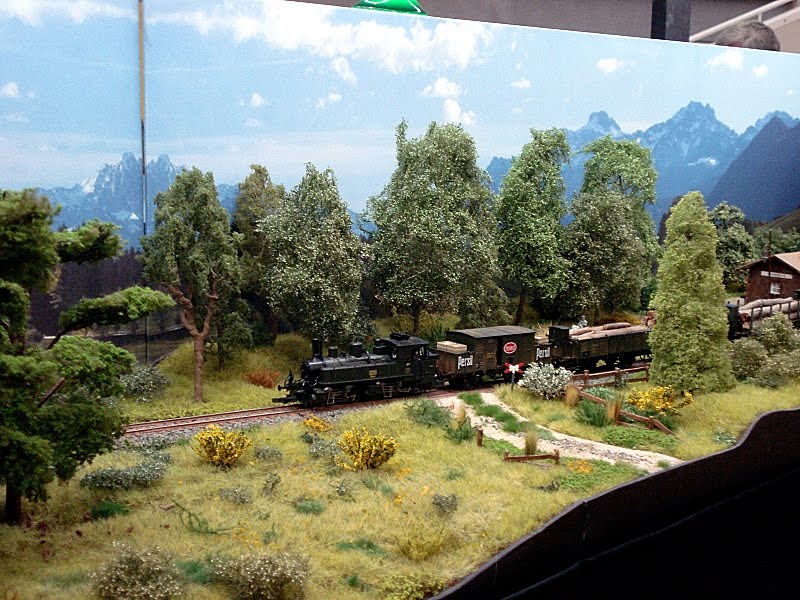
Another excellent layout was the small Quinton River layout (actually called Beauaraba Siding) that was built in 00 scale (rather unusual for Australian "prototype" layouts) and based on an Australian theme. This layout, whilst compact, had some fine scenery and buildings on display. Of special interest to me were the "invisible" stainless steel "Alex Jackson" type of couplings which worked a treat. These couplings are popular in the UK and I can see why - unobtrusive, and very effective coupling and uncoupling of wagons. The layout featured a very nice trestle which is illustrated below.
I also enjoyed the Queensland Railways (QR) S scale (1:64) Rosevale layout, which I had seen at the Brisbane Exhibition a couple of years ago. Rosevale is based on the south-east Division of the QR and set in the 1940-1960s time frame. I especially liked the buildings on this layout, particularly the pub (see photo below). The pub was based on the Railway Hotel at Imbil. My only "complaint" with this layout was that the trains seemed to be running too fast, but perhaps in S scale things just seem that way....
The Running Creek/West Goodna layout was another Queensland prototype layout in S scale. The locale is the Goodna and Redbank area in the Brisbane suburbs. However, the layout actually resides in Sydney. The layout was being exhibited for the last time. A photo of a diesel railcar crossing the steel bridge and approaching Goodna Station is in the photo below.
Of interest, was the layout called Freestone (photo below). This layout was another QR layout, this time based on the town of Freestone about 20kms east of Warwick in Queensland. The layout had a large curved backscene on which a suitable series of photos had been glued. Talking to the builder of the layout, getting the photos to stick was particularly challenging but photographic paper (?) and PVA did the trick!
Another layout at which I spent some time, was Brendale. Brendale was an HO scale Australian layout, with the occasional running of some US prototype trains as well. I had a good chat here about the merits of DCC (digital command control) and the NCE system in particular. The Brendale operators I spoke with were all very happy with the NCE system.
And speaking of DCC and curved backdrops, the Coffs Harbour Modellers modular layout was a showcase exhibit with superb lighting, scenery, and outstanding controlled running of the trains. I even spied a special guest operating the layout on Saturday morning - an office-bearer of the NMRA Australasian Region, Master Model Railroader (MMR), and DCC expert from the Central Coast of NSW.... I have seen this layout a few times now and never get tired of watching the trains roll by in such a well presented display.
The day passed quickly - looking at layouts, chatting to people we knew already and those we got to know, buying the odd item or two, and generally having a good time.
I especially want to commend the catering staff (called "Pink", from memory) who managed the food and drink demands of the crowd exceedingly well. They were well organised, well staffed, and flexible enough to take payment for small items without having to queue at the two registers at the end of the line. Well done!
Just before closing time at 5pm, David and I headed back to the train station and then to the airport. David enjoyed another QANTAS meal on the way home and we arrived back in Canberra around 8.30pm - the end of an entertaining day out.
Upon arrival at Brisbane airport, we raced over and caught the Skytrain which would take us to Fortitude Valley railway station. Luckily for me, David "shouted" me the train fare - a whopping $56 return fare for the two of us (thanks, David). We got out of the train at Fortitude Valley station, walked through the small above-station shopping centre, and then outside for the five minute walk to the RNA Showgrounds and the train show.
The train show was held in two large pavilions (one pavilion less than when I last attended a couple of years ago). The outer ring within the pavilions was where the commercial traders were mostly located and included ARHS (QLD), Auscision, Austral Modelcraft, Christmas Every Day, Chucks Ballast, Eureka Models, Forest Miniatures, Gwydir Valley Models, Horizon Hobbies, Modular Train Tables, Remote Control Systems, Train World, and Wuiske Models, among others.
Inside the commercial ring were the layouts. The layouts were generally representative of what you'd see at most model railway exhibitions, albeit with an emphasis on layouts of most appeal to the general public.
I was, however, very impressed by a Great Western Railway (GWR) branch terminus layout called Princetown, based on the prototype Princetown branch line through Dartmoor in England. The model was to 00 scale (1:76). I really liked the atmosphere created by some excellent scenery and layout composition, with a sense of spaciousness and without any unsightly clutter. I spent quite a lot of time enjoying the fine scenic detail and talking with the operators (who, oddly enough, were both keen on electricity and wiring layouts - a rare pair indeed!). The station and associated buildings were very nicely done. The GWR tank engine saw plenty of duty ferrying passengers back and forth throughout the day (see photo below).
Another excellent layout was the small Quinton River layout (actually called Beauaraba Siding) that was built in 00 scale (rather unusual for Australian "prototype" layouts) and based on an Australian theme. This layout, whilst compact, had some fine scenery and buildings on display. Of special interest to me were the "invisible" stainless steel "Alex Jackson" type of couplings which worked a treat. These couplings are popular in the UK and I can see why - unobtrusive, and very effective coupling and uncoupling of wagons. The layout featured a very nice trestle which is illustrated below.
I also enjoyed the Queensland Railways (QR) S scale (1:64) Rosevale layout, which I had seen at the Brisbane Exhibition a couple of years ago. Rosevale is based on the south-east Division of the QR and set in the 1940-1960s time frame. I especially liked the buildings on this layout, particularly the pub (see photo below). The pub was based on the Railway Hotel at Imbil. My only "complaint" with this layout was that the trains seemed to be running too fast, but perhaps in S scale things just seem that way....
The Running Creek/West Goodna layout was another Queensland prototype layout in S scale. The locale is the Goodna and Redbank area in the Brisbane suburbs. However, the layout actually resides in Sydney. The layout was being exhibited for the last time. A photo of a diesel railcar crossing the steel bridge and approaching Goodna Station is in the photo below.
Of interest, was the layout called Freestone (photo below). This layout was another QR layout, this time based on the town of Freestone about 20kms east of Warwick in Queensland. The layout had a large curved backscene on which a suitable series of photos had been glued. Talking to the builder of the layout, getting the photos to stick was particularly challenging but photographic paper (?) and PVA did the trick!
Another layout at which I spent some time, was Brendale. Brendale was an HO scale Australian layout, with the occasional running of some US prototype trains as well. I had a good chat here about the merits of DCC (digital command control) and the NCE system in particular. The Brendale operators I spoke with were all very happy with the NCE system.
And speaking of DCC and curved backdrops, the Coffs Harbour Modellers modular layout was a showcase exhibit with superb lighting, scenery, and outstanding controlled running of the trains. I even spied a special guest operating the layout on Saturday morning - an office-bearer of the NMRA Australasian Region, Master Model Railroader (MMR), and DCC expert from the Central Coast of NSW.... I have seen this layout a few times now and never get tired of watching the trains roll by in such a well presented display.
The day passed quickly - looking at layouts, chatting to people we knew already and those we got to know, buying the odd item or two, and generally having a good time.
I especially want to commend the catering staff (called "Pink", from memory) who managed the food and drink demands of the crowd exceedingly well. They were well organised, well staffed, and flexible enough to take payment for small items without having to queue at the two registers at the end of the line. Well done!
Just before closing time at 5pm, David and I headed back to the train station and then to the airport. David enjoyed another QANTAS meal on the way home and we arrived back in Canberra around 8.30pm - the end of an entertaining day out.
Subscribe to:
Posts (Atom)